Webinars aren't a top-of-funnel vanity channel. They produce some of the strongest intent signals in B2B marketing.
But most demand gen teams still treat them as isolated broadcasts: host on a third-party domain, xollect registration numbers, send a generic follow-up, and hope for pipeline.
(Spoiler: "hope" is not a strategy).
That approach leaves revenue on the table. Knowing how to use a webinar in marketing means understanding that the value is the behavior around the broadcast, not the broadcast itself. When you embed webinars directly on your website, every attendee becomes a measurable visitor.
Instead of leaking traffic to external platforms, you capture first-party data your sales team actually trusts.
This guide covers how to use a webinar in marketing across every funnel stage, how to fill the room with the right people, and how to turn one session into a month of pipeline-generating content.
Your Website Is the Venue
host it where your revenue engine lives
Your website shouldn't be a digital brochure that links out to a Zoom room when it's time for an event. When you host webinars natively on your domain, they become part of your intelligent infrastructure. Buyers give you their time and attention. Because the experience lives on your site, you capture real-time engagement data directly.
No third-party handoff, and no fragmented reports from a vendor three days later.
This means you track exactly which target accounts are actively researching your solutions. Your revenue team gets the behavioral context they need to close deals instead of a CSV of email addresses.
How to Use a Webinar in Marketing at Every Funnel Stage
Knowing how to use a webinar in marketing means matching format to funnel stage.
1. Top of Funnel: Awareness and Education
Buyers will give you significant time if the content helps them do their jobs better.
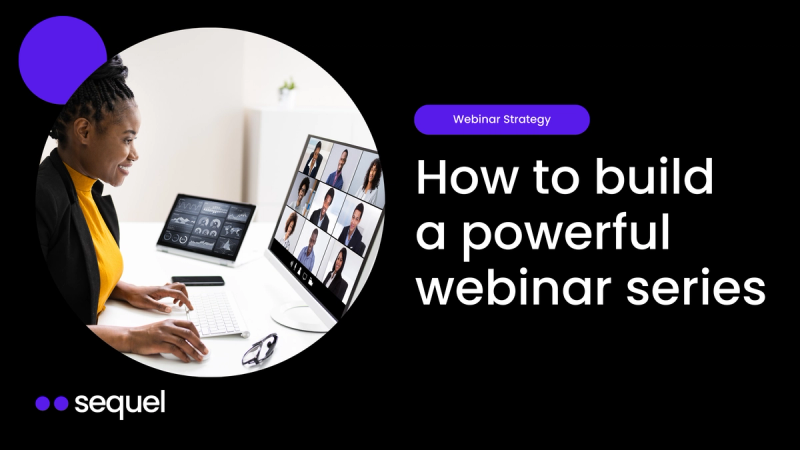
To keep audiences engaged and moving toward a buying decision, build a recurring webinar series rather than disconnected one-off events. A predictable schedule turns your website into a destination for industry education. One-off events generate spikes.
A series builds a sustained audience.
2. Middle of Funnel: Proof and Process
Host workshops and strategy sessions. Bring your most successful customers on screen to break down their exact workflows. Then, show the specific steps a peer took to achieve a measurable outcome.
This is how to use a webinar in marketing for the consideration stage: make it so specific and practical that the prospect walks away thinking "I could do that with their tool."
3. Bottom of Funnel: Demos and Decision Support
These formats close deals faster by answering questions directly.
When Userpilot deployed this strategy with strong follow-up sequences, they achieved 3x more demo bookings and a 95.2% attendance rate. The buyers were ready. They just needed a high-trust environment to validate their decision.
How to Fill the Room With the Right People
Promotion That Targets, Not Sprays
High-performing webinars see higher than average engagement rate. But that level of interaction (the best of the best) only happens when your promotion strategy filters for high-intent buyers rather than chasing vanity registration numbers.
The Urgency Sequence That Drives Attendance
- Three days out: a logistical reminder with the join link and a specific reason to attend.
- Day before: share a question or poll you plan to answer live to build anticipation.
- Ten minutes before: a "starting now" alert. This sequence creates momentum and reduces no-shows.
The 1-to-10 Content Strategy: One Webinar, Ten Assets
This is the 1-to-10 strategy.
Take a single session and extract short video clips, blog posts, social snippets, email content, and on-demand replay pages. Using Sequel AI Studio, much of this workflow happens automatically. The platform captures high-definition local recordings directly from the host machine, then generates transcripts and segmented video chapters without requiring a dedicated editor.
This approach to repurposing webinar content keeps your content calendar full and ensures your best ideas drive organic traffic long after the live session ends.
When 6sense combined this repurposing model with hosting content natively on their site, they influenced millions in pipeline and generated 14 net-new sourced opportunities.
The live broadcast is the starting line, and the derivative content is where the compounding value lives.
Connecting Webinars to Your Revenue Engine
The goal is real-time synchronization. When your webinar lives on your website, engagement data flows immediately into Salesforce, HubSpot, or Marketo: poll responses, watch time, Q&A questions, and CTA clicks.
Every signal lands in the contact record automatically.
This data fuels lead scoring models and updates campaign statuses without manual intervention. Your sales team gets alerts while buyer intent is still hot. Not the next day. Not after someone remembers to upload the CSV. Immediately.
Measuring What Actually Matters
Track attendance rates and retention curves to see where buyers drop off. But don't stop at the video player. Combine in-event actions with website behavior to create a single behavioral timeline per account. If a prospect watches 40 minutes and then visits your pricing page, that's a definitive buying signal.
73% of marketers say webinars produce their best quality leads, and the average cost per lead for webinars is just $72. You can only prove that efficiency if your systems are connected.
Tying engagement signals directly to closed deals is the only way to accurately measure the ROI of your webinar program. Stop guessing with disconnected dashboards. Start using the data your buyers are already giving you.
Putting It Into Practice
1. Assign each webinar to a funnel stage.
Top-of-funnel sessions focus entirely on industry education. Bottom-of-funnel sessions deliver high-trust product teardowns. Don't try to serve both audiences in one session.
2. Host on your domain.
Embed the event natively so every attendee generates first-party behavioral data on your website. Your analytics, retargeting, and attribution all stay intact.
3. Connect your CRM before the event.
Map custom fields so every poll response and minute watched flows into Salesforce or HubSpot in real time. Your sales team should have intent signals before the session ends.
4. Plan derivative content before you go live.
Know exactly what blog posts, clips, and social assets you'll extract from the recording. Set up repurposing workflows early so the content engine starts producing the same week.
5. Measure pipeline, not headcount.
Track which webinar attendees entered pipeline, which ones accelerated deals, and how much revenue the event influenced. That's the number that earns you more budget.
The broadcast is the beginning of a much larger conversation with your market. Every webinar attendee is a measurable website visitor generating behavioral data you can act on. That's how to use a webinar in marketing and actually prove it works.