How Unit21 Automated 80% of Post-Webinar Work with Sequel’s MCP and Claude
What if your webinar transcript could write your blogs, build your nurture sequences, cut your social clips, and prep your sales team to follow up, all in a single afternoon? That is exactly what happens when you connect AI directly to your webinar data with MCP, and it may be the most useful AI workflow in marketing right now.

Every marketer knows the feeling when you spend weeks promoting a webinar, the session goes great, your speakers drop real insight and a few quotable moments, and then the room closes. A day later, someone sends a "thanks for joining" email with a replay link, and that is usually where the story ends. One asset, one audience, one send. The replay collects dust, and 60 minutes of hard-won expertise slowly disappears into a video file nobody opens.
Nick Bennett, GTM Engineer at Unit21, decided that was too much value to leave on the table. If you are not familiar, Unit21 is a no-code platform for risk and compliance operations that helps businesses detect and manage fraud, money laundering, and other sophisticated risks. Nick runs lean, and he was not willing to let strong webinar content stop working after a single send. So instead of treating the webinar as the finish line, he rebuilt his entire post-webinar motion around one idea: the transcript is the asset, and the webinar was just how you recorded it. The engine behind it is the Sequel MCP, which feeds transcripts and engagement data straight into Claude.
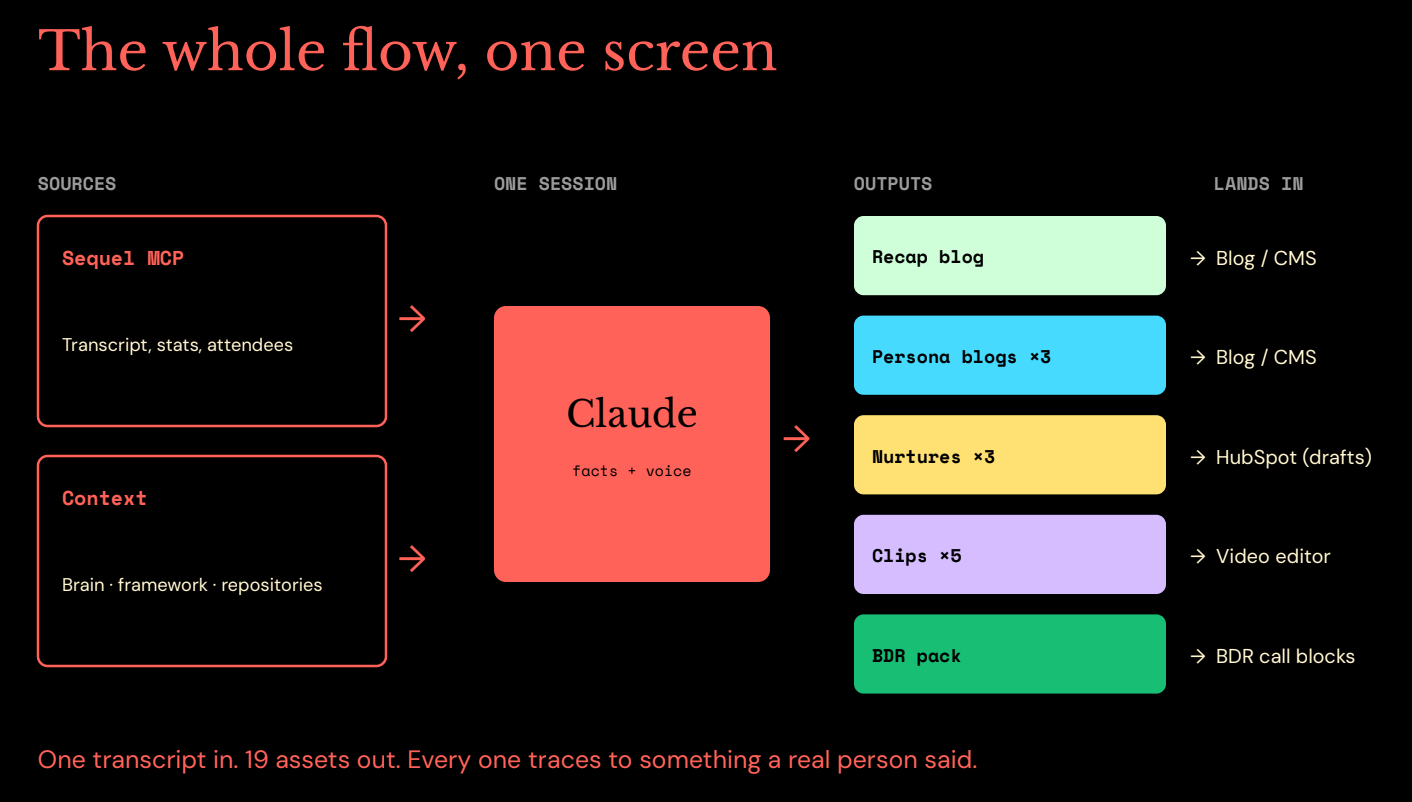
The results are hard to ignore. From a single 60-minute session, Nick's workflow now produces:
- 1 top-of-funnel recap blog
- 3 persona blogs, one per speaker and buyer
- 9 nurture emails across 3 HubSpot sequences
- 5 social clips with cut-ready timestamps
- 1 BDR pack with a prioritized call list and scripts
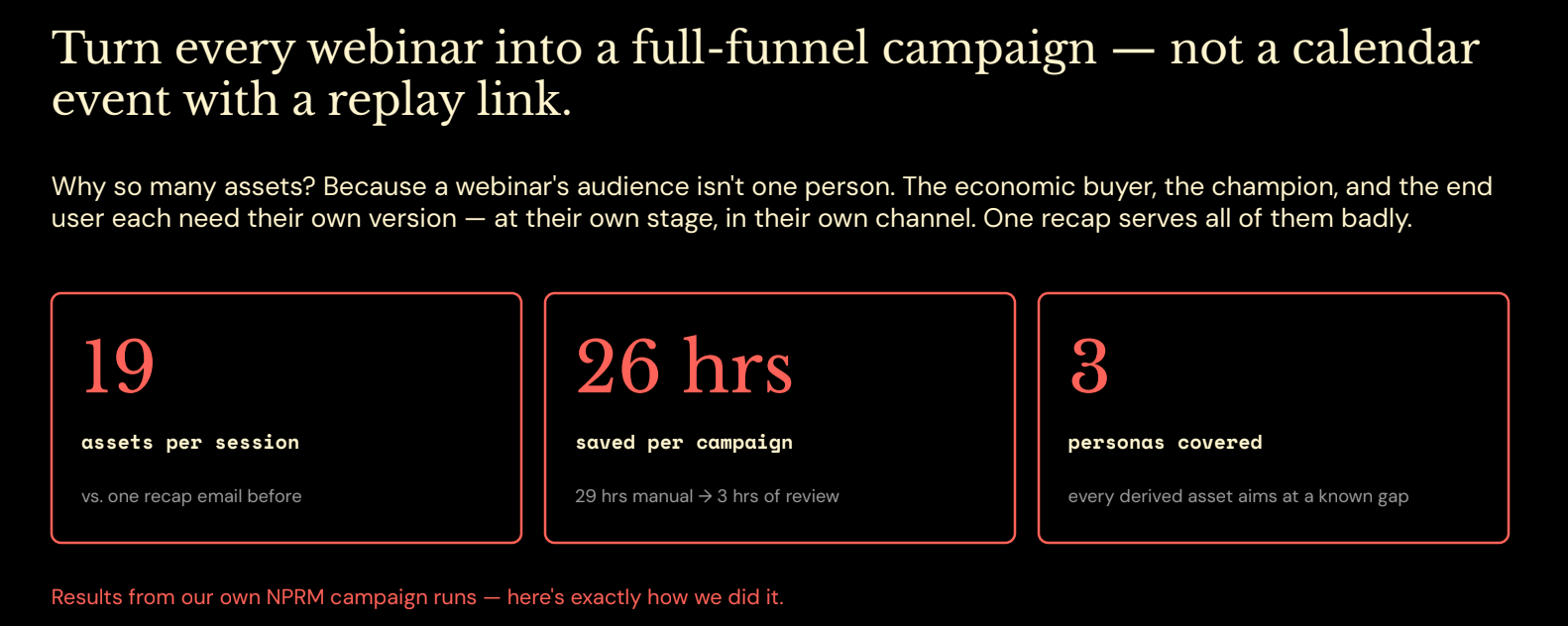
That is 19 assets from one recording, cutting post-webinar work by roughly 80%, with a recap blog that used to take 4 to 5 days now ready in about two minutes. Every one of those assets traces back to something a real person actually said on the call. Let's dive into how he built it.
The strategy behind Unit21's content multiplier
Ask most teams how they use AI for content and the conversation jumps straight to prompts. Nick's starts somewhere else, and it is the reason his output does not read like everyone else's.
When he first started experimenting, he ran into the problem everyone hits: a good prompt against a raw transcript gives you fast content that sounds generic. Technically fine, completely forgettable, and obviously written by a machine. The missing ingredient was not a cleverer prompt. It was context.
That led to the belief at the center of his whole system. The transcript is the asset, and the webinar was just how you recorded it. A 60-minute session already contains the hooks, the quotes, the objections, and the live demos. The job is not to write from a blank page but rather to route that raw material to the right buyer, in the right format, at the right stage of the funnel.
That reframe changes the question entirely. Instead of asking Claude to "summarize the webinar," Nick maps one transcript against every persona and every funnel stage. A single recording becomes awareness content, consideration content, nurture, distribution, and sales activation, all in the same afternoon.
Advice from Nick: An MCP without context produces generic content fast. An MCP plus your knowledge base produces your content fast. Build the brain first, and the prompts get short.
Building the foundation: the Sequel MCP and the "Unit21 Brain"
Two pieces make this workflow possible, and neither is a clever prompt.
The first is the Sequel MCP. MCP, or Model Context Protocol, is an open standard that lets an AI assistant plug directly into your tools, the same way USB-C lets any device plug into any charger. Sequel holds the data: events, transcripts, attendance, engagement, and leads. The MCP server exposes that data as safe, read-only tools that Claude can call in plain English. You never export a CSV or paste in a transcript again. You connect it once, then you just ask.
With the Sequel MCP connected, Claude can:
- List every webinar you have run and pull full, PII-cleaned transcripts with timestamps
- Return per-event stats: registered, attended live, watched on demand, attendance rate, and engagement across chat, polls, and Q&A
- Pull the full attendee list with watch time, chat messages, poll votes, questions asked per person, and audience insights
- Surface lead intelligence and your top accounts by activity, ready to hand to sales
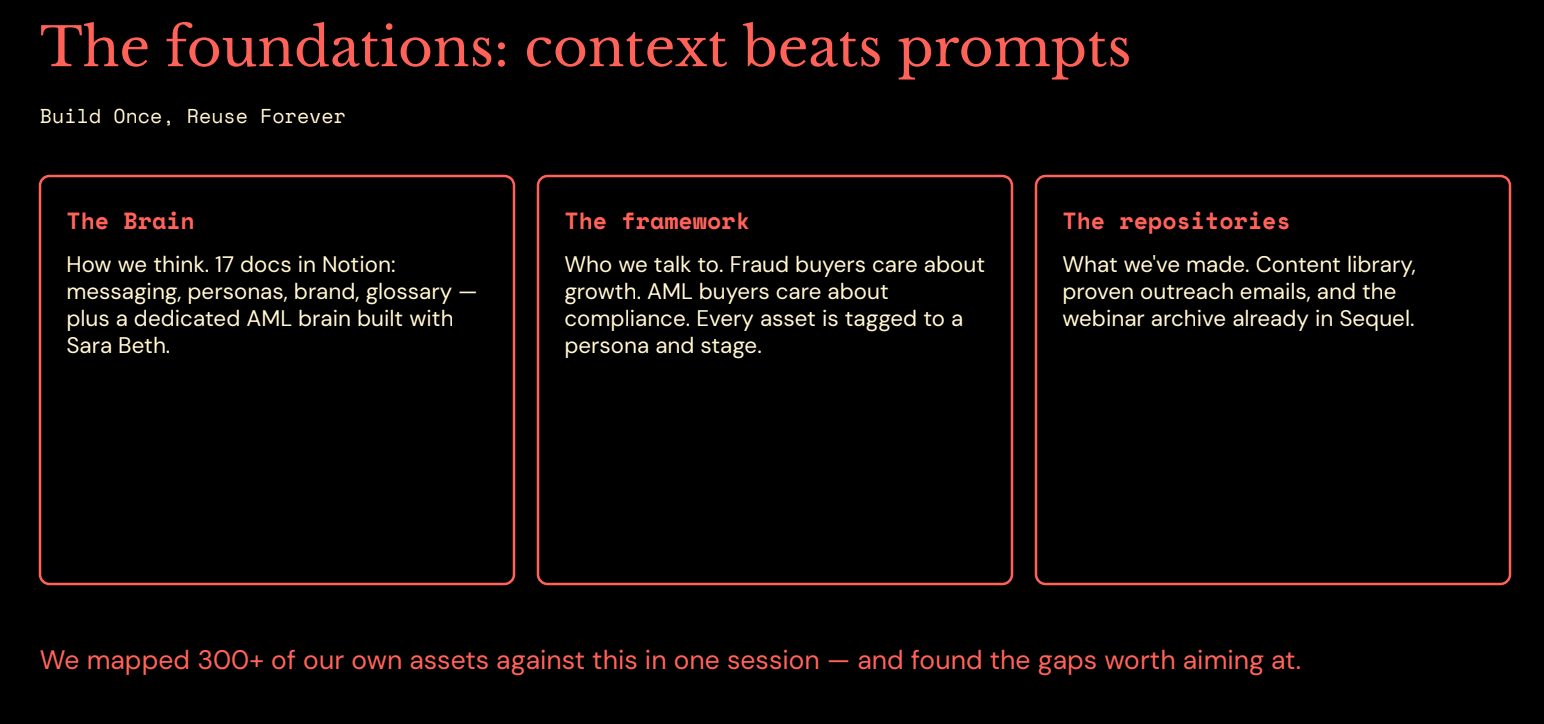
The second piece is what Nick calls the "Unit21 Brain." It is a shared Notion knowledge base of 17 documents: the messaging guide, user personas, competitive landscape, brand system, glossary, and deep domain knowledge, including a dedicated AML section built with one of Unit21's subject-matter experts. When Claude drafts anything, the transcript supplies the facts and the Brain supplies the positioning and the voice. External numbers come only from a verified-metrics table with as-of dates, so nothing gets invented. The fraud versus AML split, the persona definitions, even the tone of the writing all come from the Brain rather than from a prompt typed on the fly.
Advice from Nick: Have Claude scrape your five most recent published blogs and describe the tone, structure, and style before it writes anything. The first draft comes back already close to publishable.
On top of the Brain, Nick built two repositories that make the workflow repeatable: a content library, where every blog, webinar, and customer story is mapped against the messaging framework, and an outreach email library of the BDR emails that already convert. The first time he pointed Claude at his own content library, the exercise mapped more than 300 assets to Unit21's six personas in a single session. It surfaced gaps the team had never quantified, like a thin top-of-funnel for AML buyers and underserved analyst personas. Now every new asset is aimed at a known hole, not a guess.
The playbook: turning one transcript into a full funnel
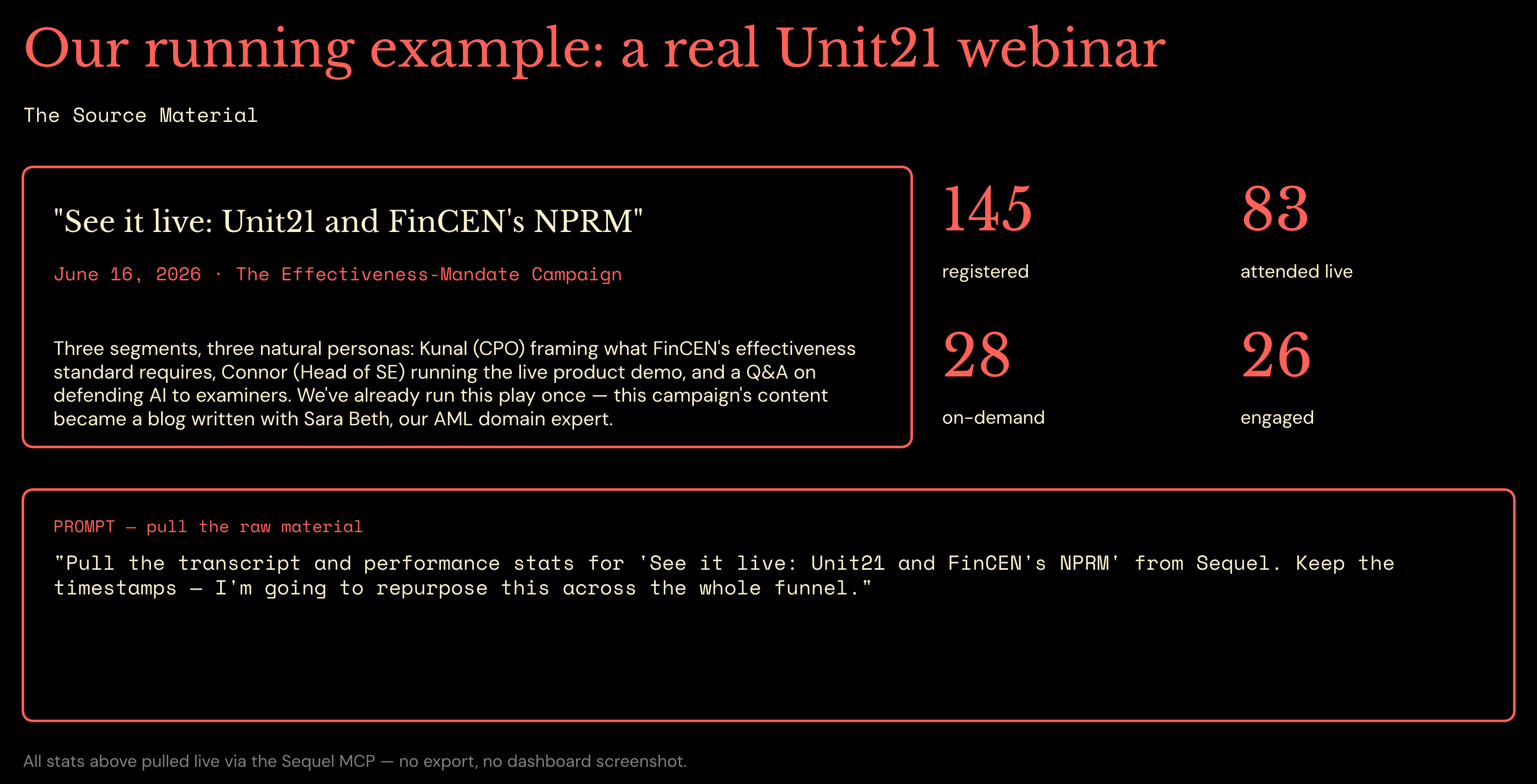
To make this concrete, we can use a real Unit21 webinar as a running example: "See it live: Unit21 and FinCEN's NPRM." What makes it a perfect teaching case is that it naturally split into three segments, each aimed at a different buyer. Kunal, the CPO, opened by framing what FinCEN's effectiveness standard actually requires. Connor, the Head of Solutions Engineering, ran a live demo, walking a real alert end to end. And the closing Q&A tackled the question every compliance leader is bracing for: how do you defend an AI model to an examiner. Three speakers, three personas, one transcript.
The whole workflow starts with a single prompt to pull the raw material:
PROMPT
"Pull the transcript and performance stats for 'See it live: Unit21 and FinCEN's NPRM' from Sequel. Keep the timestamps. I'm going to repurpose this across the whole funnel."
Every stat that follows was pulled live through the Sequel MCP. No export, no dashboard screenshot, no copy-paste.
Output 1: The top-of-funnel recap blog (Awareness)
This one is for people who have never heard of you. It ranks, it shares, and it feeds the top of the funnel. The trick is that the transcript already contains the perfect opening. This session kicked off with a poll question, "An examiner walked in today and asked how you know your program is effective. How would you answer?" That line becomes the first sentence of the blog. Claude finds it in seconds, so nobody has to rewatch an hour of video hunting for the hook.
PROMPT
"First, review our five most recent published blogs and describe the tone, structure, and style patterns. Then, using the transcript, write a 700-word top-of-funnel recap blog in that same voice. Sentence-case title, grade-9 reading level. Open with the strongest audience question, not with our company. Pull 2 to 3 direct speaker quotes with timestamps. End with the on-demand registration CTA."
Output 2: One blog per speaker, per persona (Consideration)
Here is where the multiplier really kicks in. Because each speaker was talking to a different buyer, each segment becomes its own consideration-stage blog:
- Kunal's framing becomes a blog for the economic buyer, the compliance leader who answers to examiners and needs to prove the program works.
- The validation Q&A becomes a blog for the champion, giving the BSA officer the logic to defend AI internally and to a third party.
- Connor's demo becomes a day-in-the-life piece for the end user, the analyst who actually works the alerts.
Same transcript, three different buyers, zero extra interviews. The rule that keeps it honest is simple: anchor every piece to what was actually said. If a claim is not in the transcript, it does not go in the blog.
Output 3: Persona nurtures, straight into HubSpot (Nurture)
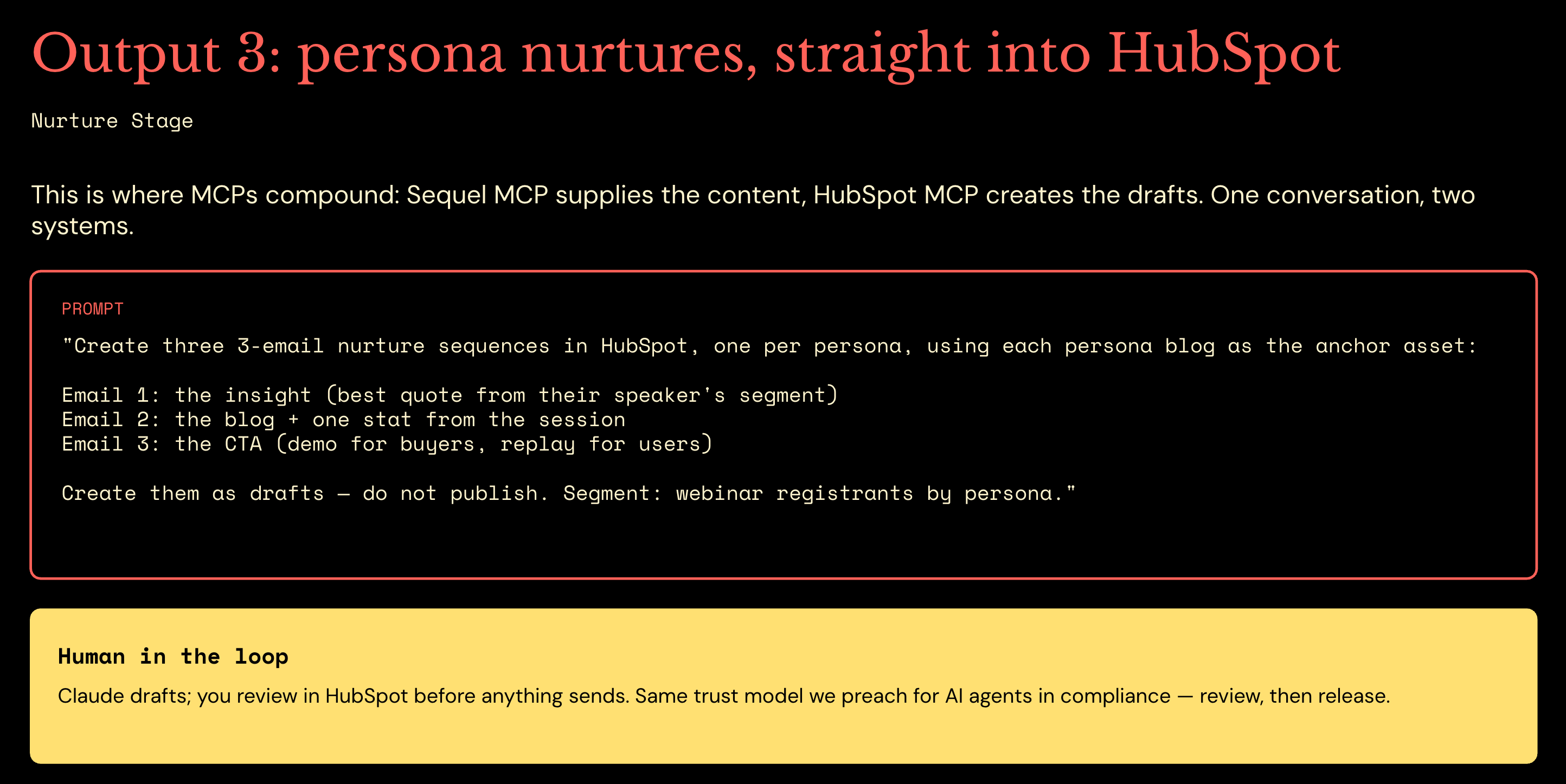
This is where MCPs start to compound. The Sequel MCP supplies the content, and the HubSpot MCP creates the in-platform drafts, so one conversation touches two systems. Nick asks Claude to build three 3-email sequences, one per persona, each anchored to that persona's blog. Email one leads with the insight, email two brings the blog plus a stat from the session, and email three makes the ask. Everything lands in HubSpot as a draft, segmented by persona, and nothing sends until a human reviews it.
Output 4: Social clips with exact timestamps (Distribution)
Next, Nick asks Claude to find the five most clip-worthy moments in the transcript and return exact timestamps, a one-line LinkedIn hook, and why each works on its own. For this example session, that surfaced the opening examiner poll, the live demo of the agent reasoning through a watchlist hit, and the Q&A everyone screenshots about how to validate a model. The timestamps come from the SRT file Sequel already has, so a video editor gets clean in and out points instead of homework. What used to take 1 to 2 hours of scrubbing per clip now takes minutes.
Output 5: The BDR summary and call-down script (Sales Activation)
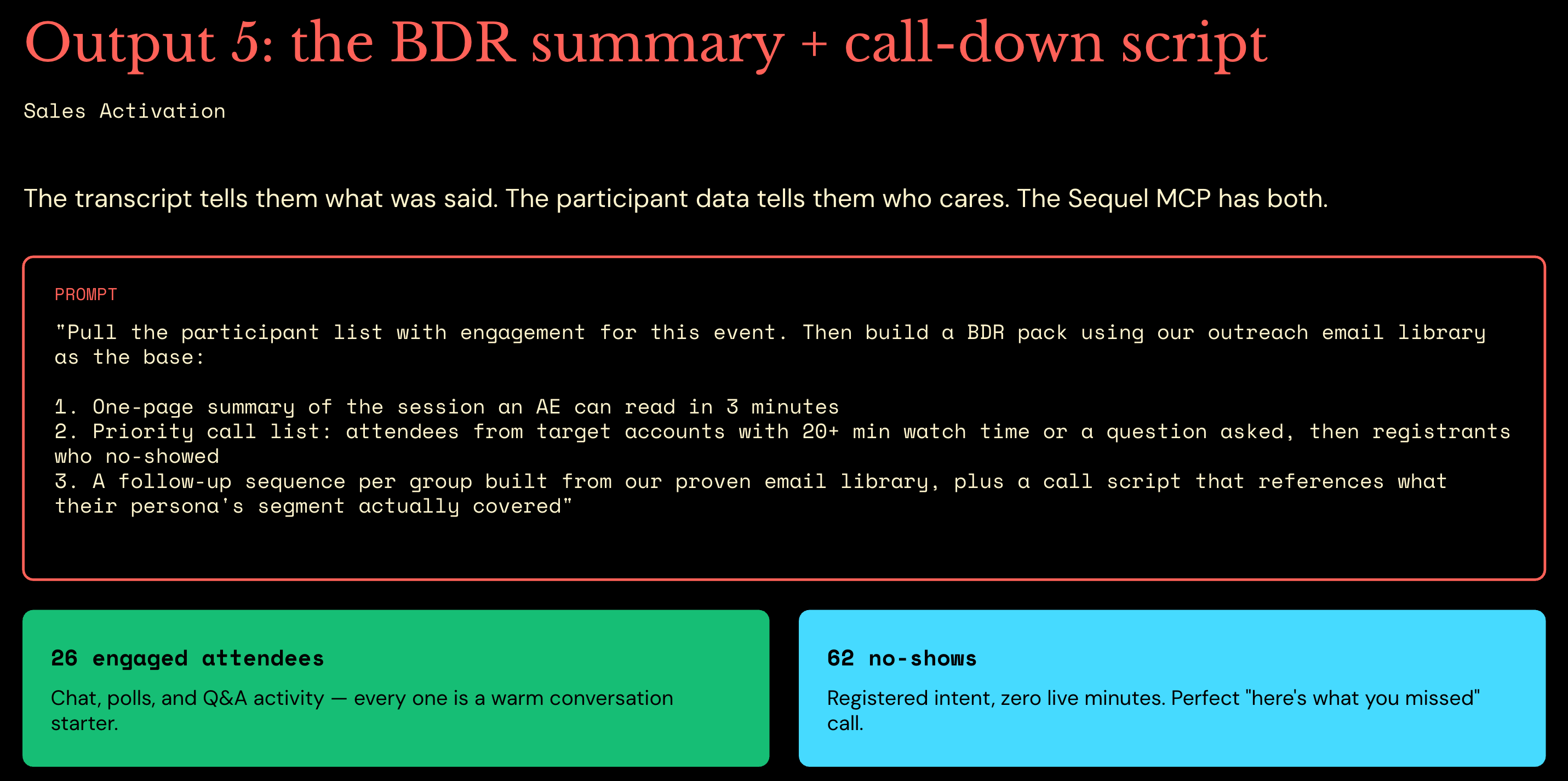
The transcript tells sales what was said. The participant data tells them who cares. The Sequel MCP has both, and that combination is what turns a recording into pipeline. Nick pulls the participant list with engagement, then has Claude build a BDR pack from the proven outreach library: a one-page summary an AE can read in three minutes, a priority call list ranked by watch time and questions asked, and a follow-up sequence with a call script tuned to each persona's segment. For this session that meant 26 engaged attendees who are warm conversation starters and a set of registrants who did not make it live and are perfect "here's what you missed" calls.
Beyond content: ask your program questions
Once every transcript and every stat lives behind one MCP, your webinar program stops being something you report on and becomes something you can interrogate. Nick asks questions like, "Which of our last 10 webinars had the best attendance rate, and what did they have in common?" and "Which target accounts have attended two or more events this quarter? Rank them by total watch time."
What keeps it trustworthy
For a company whose entire product is trust, the workflow has to be defensible. Nick built in four guardrails:
- Quotes get verified. Every quote carries a timestamp, so spot-checking it against the recording takes seconds. If it is not in the transcript, it does not ship.
- PII is cleaned upstream. Nick strips personally identifiable information from transcripts before Claude ever sees them.
- Drafts, not sends. HubSpot sequences land as drafts. A human reviews every asset before it reaches a prospect.
- Voice stays yours. The transcript supplies the facts, and your brand docs supply the voice.
Make it repeatable: turn the workflow into a skill
The first run through this playbook is manual. After that, Nick recommends saving your prompts as a Claude skill, a saved playbook Claude follows every time. Without one, every run starts from scratch and quality depends on who is typing. With a skill, "Run webinar repurposing on last week's event" is the entire prompt, and the funnel map, the voice rules, and the guardrails all come along automatically. Build it once, right after your first manual run, and anyone on the team can produce the same output.
The multiplier, counted
It is worth putting real numbers on what this saves. From one 60-minute session, Unit21 produces 19 assets. By hand, Nick estimates that stack would take around 29 hours, and be honest, most of it never got done at all. Reviewing what Claude drafts takes about 3 hours maximum for the same output.
- Recap blog: 4 hours by hand, 30 minutes to review.
- 3 persona blogs: 12 hours by hand and rarely done, 1 hour to review.
- 9 nurture emails: 6 hours by hand, 30 minutes to review.
- 5 social clips: 3+ hours of scrubbing video, 30 minutes to review.
- BDR list and scripts: 4 hours by hand, 30 minutes to review.
The real unlock is not the 29 saved hours. It is that most of it, the persona blogs especially, never used to get done at all. The content did not just get faster; it started to exist.
Replicating Unit21's playbook
Three ideas make this whole system work, and you can apply all three to your own program:
- The transcript is the asset. The webinar was just how you recorded it. Everything you need is already in the room.
- Map speakers to personas. Every speaker segment is a different buyer's blog, so one recording becomes consideration content for your whole audience.
- Content plus engagement data is what builds pipeline. The words tell you what was said. The participant data tells you who to call.
Build the Brain first, connect the Sequel MCP, and bring your last webinar. You are not writing anymore. You are routing.
Want to turn your own webinars into a demand generation engine like Unit21's? Find time with us to see what the Sequel MCP can do inside your stack.