Webinar data only becomes useful when you can trust who it belongs to.
Marketing teams increasingly rely on webinar engagement to answer questions that go far beyond attendance. The data from Sequel webinars can answer questions like who showed meaningful interest, which accounts have multiple people engaging, who asked a question or responded to a poll, who watched most of the session or visited a product page afterward, and who should Sales follow up with first?
All of those questions depend on one thing happening correctly at the beginning: the person engaging needs to be associated with the right identity.
That sounds simple. In practice, one forwarded confirmation email can break the connection.
Here’s how it usually happens. A registrant forwards their personal join link to a coworker. Both people enter using the same registration. The webinar runs and both people get value from the content, but from the data's perspective, two people can suddenly look like one.
When that happens, it becomes difficult - if not impossible - for marketers to answer the most critical questions that help turn webinar engagement into pipeline. Questions like who actually watched the session, who asked the question, was that CTA click from the person who registered or the colleague who used their link, and does the engagement score represent one buyer's behavior or two people's combined activity?
The information exists - the problem is whether you can trust what it represents.
Clean data starts before the webinar begins
B2B marketing teams are under more pressure to turn engagement into useful business signals, and webinars provide rich engagement data.
But simple registration and attendance data are no longer enough. With clean engagement data - including answers to poll questions, chat engagement, CTA clicks, website page visits, and more - demand generation teams can prioritize the people showing real intent, marketing operations teams can get reliable data flowing into CRM and automation systems, sales can make their follow-up more relevant, and marketing leaders can confidently connect webinar engagement to pipeline and revenue.
The richer the data becomes, the more important identity becomes.
If webinar behavior feeds a lead score, the person behind that behavior needs to be correct. If several people from one account are engaging, you want to recognize the buying committee rather than collapse them into a single contact. If Sales follows up on a question asked during a session, they need confidence that the person on the CRM record was actually the one who asked it.
And as AI becomes part of more marketing workflows, data quality matters even more.
AI can summarize activity, identify patterns, prioritize engagement, and help teams decide what to do next. But it cannot fix an identity problem that happened at the point of entry. If two people appear as one person, every downstream system is starting with the wrong context.
In short, good outputs begin with good inputs.
Protect identity at the point where engagement begins
High-performing teams do not treat data quality as something to clean up after a webinar, they protect it at the moment the data is created. That means each attendee enters under their own identity, and their registration belongs to them. Their questions, watch time, poll responses, CTA clicks, and other behaviors can then be associated with the person who actually generated them.
When someone else wants to attend, the better outcome is not to let them disappear behind a coworker's registration - it’s to capture them as another real person who chose to engage. That creates a cleaner operating model for everyone downstream.
Clean going in. Clean coming out.
How Sequel protects webinar data integrity
Unique Join Code Enforcement is a company-wide setting in Sequel designed to prevent multiple people from entering an event under the same registration.
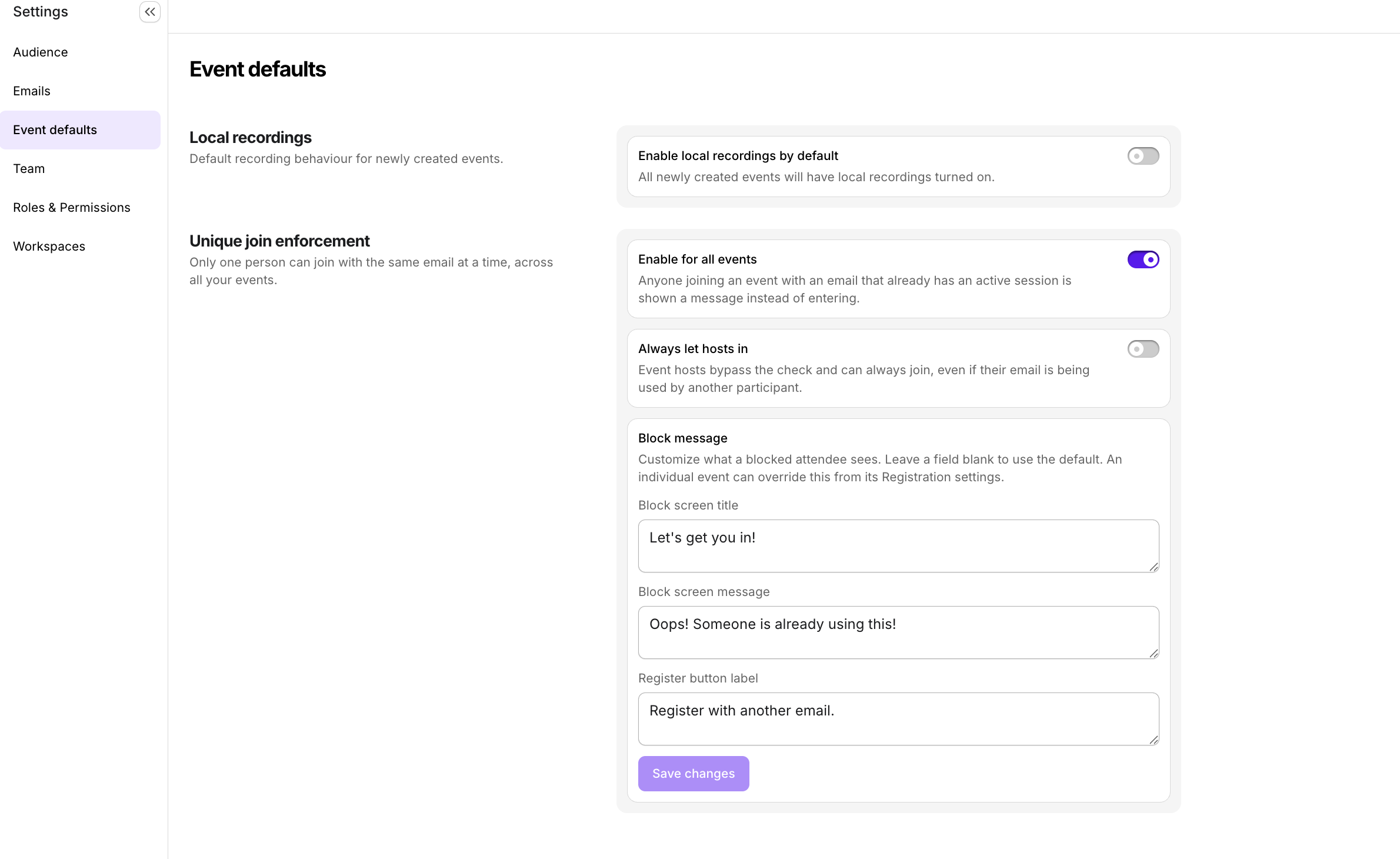
Every registrant already receives a personal join code as part of their event link. When Unique Join Code Enforcement is enabled, a second person attempting to enter with a join code that is already being used is blocked. Instead of joining as someone else, they are prompted to register with their own email.
That distinction matters. The goal is not simply to restrict access, it’s to preserve the connection between a person and the engagement they generate.
The experience works whether attendees join directly through Sequel or participate in an event embedded on your own website. That means teams can protect registration integrity without giving up Sequel’s owned-site experience that connects webinar engagement with the rest of the audience journey.
Hosts are treated differently. Because event teams may need to use a host link across multiple devices or locations, Sequel includes an Always Let Hosts In setting that allows host links to bypass enforcement.
The result is tighter attendee data without creating unnecessary friction for the people running the event.
What this looks like in practice
The value becomes clearest when you look at the decisions teams make with webinar data every day.
- Demand Generation: A webinar ends and the team wants to identify the people showing the strongest buying signals. One attendee watched nearly the entire session, answered a poll, and clicked a product CTA. Those behaviors are much more useful when the team knows they came from one identifiable person, rather than potentially being a combination of activity from several people sharing a link. Cleaner identity makes prioritization more credible.
- Marketing Operations: Event activity flows into CRM and becomes part of scoring, segmentation, and reporting. A shared registration can introduce ambiguity before any of those workflows begin. By requiring additional attendees to register separately, the team protects the quality of the records entering downstream systems instead of trying to diagnose questionable engagement later.
- Event Marketing: Someone forwards their confirmation email to a colleague who also wants to attend. Instead of the colleague joining invisibly under the original registration, Sequel asks them to register with their own email. The attendee can still get to the event, while the marketing team gets a more accurate picture of who actually participated.
- Sales: A rep sees that a prospect attended a webinar and asked a detailed question about a product use case. That context can make follow-up much more relevant, but only if the activity is associated with the correct person. Better identity at entry creates more confidence in the engagement context Sales receives later.
- Marketing leadership: When webinar engagement contributes to attribution and pipeline reporting, the reliability of the underlying records matters. Unique attendee identities do not guarantee better pipeline, but they create a stronger foundation for measuring who engaged and connecting that activity to later outcomes.
Better intelligence depends on better context
Sequel's broader approach to webinars is built around understanding engagement in context. Because Sequel can host webinars directly on your website, the event does not have to exist as an isolated record in a third-party destination. Instead, webinar behavior can sit alongside the broader first-party journey, including what someone explored before the event and what they did afterward.
That creates richer context for Audience Insights, CRM workflows, scoring, account-level analysis, and the broader intelligence layer around your programs, but more context is only valuable if the underlying identity is reliable.
A sophisticated scoring model cannot compensate for two people using one record, and account intelligence becomes less useful if additional members of a buying committee remain hidden behind someone else's registration. AI can reason over the context it receives, but the quality of that reasoning starts with the quality of the data.
Unique Join Code Enforcement addresses the problem at its source by ensuring that when Sequel learns from someone's engagement, it is learning about the right person.
Book a demo to learn more about Sequel.
Frequently Asked Questions
What is Unique Join Code Enforcement in Sequel?
Unique Join Code Enforcement prevents multiple people from using the same registrant link to join a Sequel webinar or event at the same time. If a second person tries to enter with a join code that is already in use, they are prompted to register with their own email instead.
Why should webinar teams use unique join links?
Unique join links help protect the accuracy of your webinar data by keeping each attendee’s engagement tied to their own registration. This is especially important if your team uses attendance, watch time, questions, polls, or other engagement data for reporting, lead scoring, attribution, or Sales follow-up.
What happens if someone forwards their Sequel webinar confirmation email?
If Unique Join Code Enforcement is enabled and the original registrant is already using the link, a second person trying to join with that link will be blocked from entering under the same registration. They can register with another email to join as a separate attendee, or try the original link again if it is no longer in use.
Does Unique Join Code Enforcement work for webinars embedded on my website?
Yes. Unique Join Code Enforcement works whether attendees join directly through Sequel or through a Sequel event embedded on your website. For embedded events, attendees are directed through the appropriate event experience while the same join-code rules are enforced.
How do I enable Unique Join Code Enforcement in Sequel?
Unique Join Code Enforcement is a company-wide setting located under Settings > Event Defaults in Sequel. Once enabled, the setting applies across your company’s events rather than needing to be configured separately for each webinar.
Can hosts still join from multiple devices when Unique Join Code Enforcement is turned on?
Yes. Sequel includes an Always Let Hosts In setting that allows host links to bypass Unique Join Code Enforcement. This lets hosts join from multiple devices or locations without weakening the identity controls applied to attendees.
Is Unique Join Code Enforcement included in all Sequel plans?
Yes. Unique Join Code Enforcement is available on all Sequel plans and does not require a separate add-on. Customers can enable it as a company-wide setting whenever they want to protect attendee identity and webinar data quality.
How is Unique Join Code Enforcement different from manually cleaning webinar data after an event?
Unique Join Code Enforcement helps prevent an identity problem before the engagement data is created. If multiple people participate under one registration, it can be difficult to determine afterward who watched, asked a question, or responded to a poll, so preventing shared active links gives downstream reporting and follow-up cleaner data to work with.