Sanity Integration
Running webinars is only part of the marketing team's job. For every event a marketing team launches, there is also a website workflow behind it. The event needs a page. The title, description, speakers, dates, and registration experience need to be correct. If something changes, the website has to change too. If the event is removed, someone has to make sure an outdated page or record is not left behind.
For teams using a headless CMS like Sanity, that work often crosses multiple systems and multiple owners.
A Demand Gen manager creates the webinar. An Event Marketer updates a speaker. Marketing Ops manages the event platform. A web developer maintains the Sanity content model. Somewhere in the process, someone copies information from one system into another and hopes both stay aligned — the new date, the right webinar connected to the right page, the CMS record cleaned up once an event is deleted.
The information already exists. Keeping it synchronized is the hard part.
Manual website maintenance gets more expensive as webinar programs grow
Teams putting on a one-off webinar can tolerate a little manual work. But that work starts to compound when they go from one event to a weekly series, a global program with regional sessions, product launches, customer education, recurring thought leadership, and a growing on-demand library.
At the same time, marketing teams are being asked to move faster with fewer operational handoffs. Websites are becoming more sophisticated. Headless CMS platforms give teams greater flexibility over how content is structured and reused, but that flexibility also makes clean system connections more important.
Copying event information between a webinar platform and a CMS may look like a small task in isolation. Repeated across dozens or hundreds of events, it becomes a fragile operating model — every manual handoff creates another opportunity for outdated dates, incorrect event IDs, missing speaker changes, stale content, or a delayed campaign launch. More importantly, it puts web maintenance in the middle of work that should be routine for a marketing team.
The problem is that the systems responsible for the webinar and the website should not require people to keep the same information aligned by hand.
The better model is one source of event truth, connected to the website
High-performing teams reduce that duplication by giving each system a clear job.
- The webinar platform manages the event.
- The CMS manages structured website content.
- The website delivers the experience to the audience.
When those responsibilities are connected, marketers do not have to recreate the webinar every time it needs to appear on the site. They manage the event where the event already lives, while the CMS receives the information it needs to power the website experience.
That changes some very ordinary but important parts of the work.
A date changes once, not twice. A deleted event does not create a separate CMS cleanup project. An event identifier does not need to be repeatedly copied from one system to another. The web team builds the integration once instead of supporting the same publishing process event after event.
The result is a more reliable way to operate a webinar program at scale, not simply fewer steps to follow.
Bringing Sequel and Sanity into the same workflow
Sequel has long supported running webinars directly on a company's website, including sites powered by Sanity. Previously, teams could create webinar content in Sanity, add the corresponding Sequel Event ID, and use that structured content to render the Sequel experience on their site.
The new Sequel + Sanity integration extends that foundation by connecting the event lifecycle itself. When a webinar is created in Sequel, the corresponding webinar content can be created in Sanity. When the event changes, the Sanity content can be updated. When the event is deleted, the corresponding content can be removed.
Marketers continue managing the webinar in Sequel. Sanity continues serving as the structured content layer for the website. The integration keeps the two connected — not to replace Sanity or change how a company has built its website, but to make webinars behave more naturally inside that architecture.
Here’s what it actually looks like, today, on Sanity’s website (they’re a Sequel customer too!):
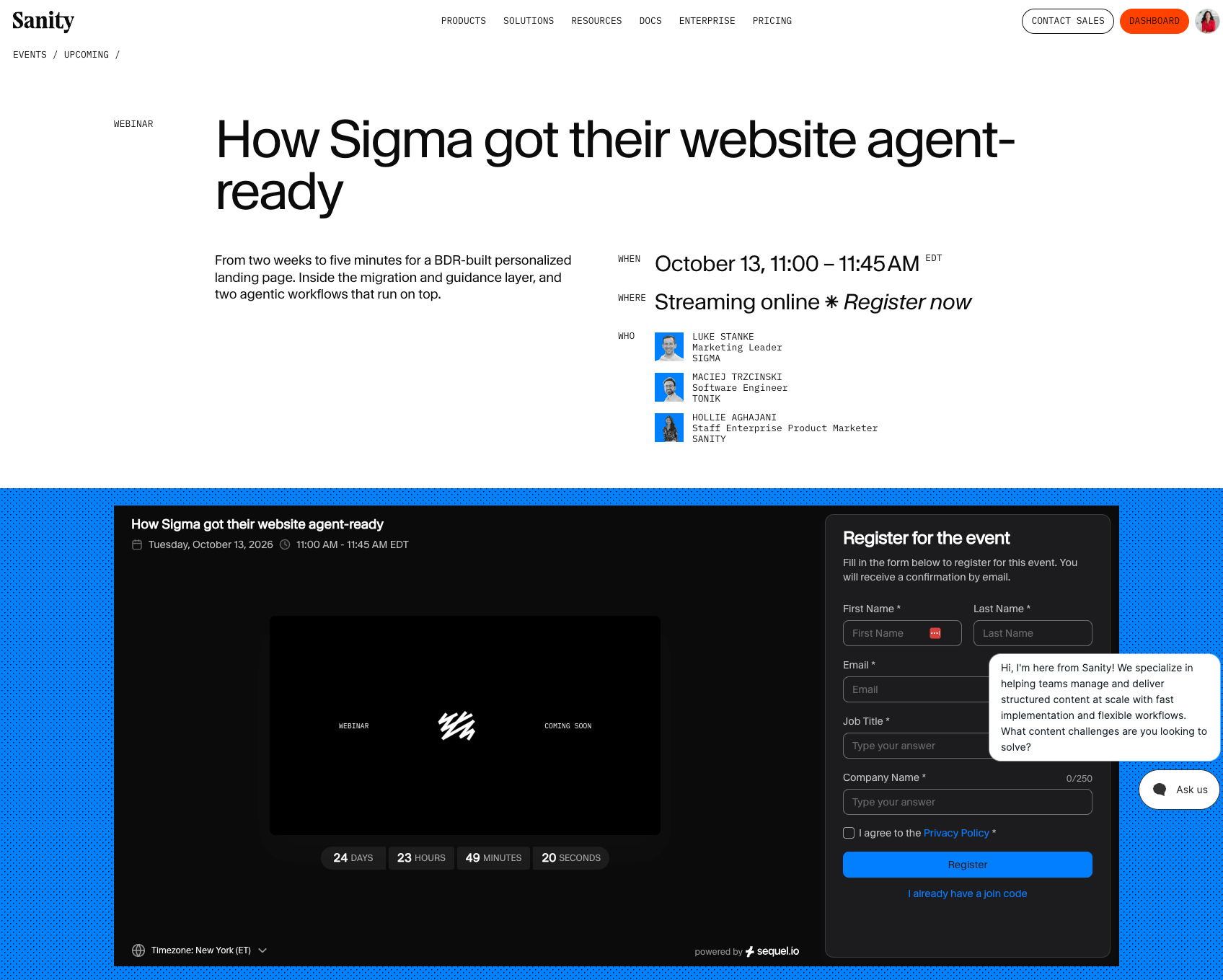
For teams that have invested in Sanity precisely because they want reusable, structured content and control over their frontend experience, webinars can now fit into the same model.
What this looks like in practice
The most useful workflows are not dramatic. They remove the small pieces of operational friction that accumulate every time a team launches an event.
- Demand Generation: A campaign owner creates a new webinar in Sequel and needs the website experience ready for promotion. Instead of opening Sanity and recreating the event information, the corresponding content enters the CMS workflow through the integration. The team can focus on the campaign, audience, and conversion strategy rather than duplicating event setup.
- Event Marketing: A speaker changes the morning before a session, or the webinar needs to move to a different date. The marketer updates the event in Sequel rather than tracking down every place the information was entered. The corresponding Sanity content stays aligned, reducing the risk that the website promotes outdated details.
- Marketing Operations: The team wants to scale from a handful of webinars to a recurring program without creating another manual process to maintain. Connecting Sequel and Sanity replaces repeated CMS entry with a defined integration, giving Operations a workflow that is easier to govern as event volume increases.
- Web and Digital: The website team wants webinars to fit its existing Sanity architecture rather than introducing a separate event destination or building a new page process for every launch. The team can use structured Sanity content to determine where and how webinar experiences appear while Sequel handles the webinar itself.
- Content Marketing: A company is building a resource center that includes upcoming and on-demand webinars alongside other content. Because webinar information can live within the same structured CMS environment, the content team has a cleaner foundation for organizing those experiences across the website.
In each case, the important change is the same: the marketer manages the event, while the systems handle more of the synchronization surrounding it.
Your webinar should behave like part of your website
This integration also reflects a larger change in how B2B teams think about webinars.
For years, the standard workflow treated the company website as a place to promote the webinar, then sent the audience somewhere else to experience it. That separation creates more than a brand problem. It breaks the continuity of the digital relationship.
Someone may read an article, explore a product page, register for a webinar, ask a question during the session, and visit another page afterward. Those are not isolated interactions. They are different moments in the same relationship.
Sequel runs webinars directly on the customer's website, where that broader relationship is already happening. That means a Sanity-powered site does not have to treat the webinar as an external destination. Sanity can continue managing the website content and presentation, while Sequel powers the live and on-demand experience within it.
When Audience Insights is also part of the customer's Sequel setup, the value goes further. Webinar engagement can be understood alongside broader first-party website behavior, giving marketing teams more context about what people actually care about before, during, and after a session.
The CMS integration makes it easier to operate the website experience. The owned-site model makes that experience more useful to the broader go-to-market motion.
What changes after adoption
The biggest changes show up in work that marketing teams no longer need to repeat.
- Teams do not need to recreate the same webinar information in Sanity every time they launch an event.
- They do not need a separate CMS update whenever routine event information changes.
- They do not need to remember to clean up the corresponding content when an event is deleted.
- Marketing Ops has fewer recurring synchronization tasks to manage. Web teams receive fewer basic publishing requests. Demand Gen and Event Marketing can move from creating the event to promoting it with fewer system handoffs in between.
- And as webinar volume grows, the operational cost does not have to grow at the same rate.
That matters because the point of better marketing infrastructure is not simply to automate more tasks. It is to remove administration that gets in the way of the work marketers are actually there to do: create useful programs, bring people together, understand what they care about, and turn that engagement into something meaningful.
Getting started
The Sequel + Sanity integration is designed for teams using Sanity as the content layer for their website.
Because Sanity is a programmable headless CMS, initial setup requires access to the customer's Sanity project and website implementation. Teams should involve the person responsible for their Sanity environment or frontend architecture during configuration.
Once the integration is in place, Sequel and Sanity can keep webinar content aligned across event creation, updates, and deletion, while the website uses that content to render the appropriate Sequel experience.
Customers can use Sequel's setup documentation for guidance on configuring the Sanity content structure, connecting the systems, and rendering Sequel on the website.
The Sequel + Sanity integration is available now, and is included on all Sequel plans at no additional cost.
Spend less time maintaining the webinar. Spend more time making it matter.
Marketing teams already have the event information. Their CMS already has a job. Their website is already where the broader audience relationship is happening. The unnecessary part is making people carry the same information between those systems over and over again.
Connecting Sequel and Sanity removes more of that maintenance so webinar programs can operate like a native part of the website, even as the number of events grows.
Create the webinar once, keep the website aligned, then focus on what happens when people actually show up.
Your Questions, Answered
What is the Sequel Sanity integration?
The Sequel Sanity integration connects webinars managed in Sequel with the structured content powering your Sanity website. When an event is created, updated, or deleted in Sequel, the corresponding Sanity content can stay aligned without your team manually maintaining the same event in both systems.
Who is the Sequel Sanity integration designed for?
The Sequel Sanity integration is designed for B2B marketing teams using Sanity to power their website and Sequel to run webinars or virtual events. It is especially useful for Demand Gen, Event Marketing, Marketing Operations, and web teams running recurring webinar programs or maintaining growing event and on-demand content libraries.
How does Sequel integrate with Sanity?
Sequel sends webinar information into the customer's Sanity content structure so the website can use that data to display the correct Sequel experience. Sequel remains the place where the webinar is managed, while Sanity continues to manage the structured content used by the website.
Does the Sequel Sanity integration keep webinar updates in sync automatically?
Yes. Once the integration is configured, webinar content in Sanity can stay aligned when the corresponding event is created, updated, or deleted in Sequel. This reduces repeated CMS updates and helps prevent outdated event information from remaining on the website.
Does the Sequel Sanity integration require coding?
The initial setup requires technical access to your Sanity project and website implementation, so a developer or web team will typically be involved. After that setup, marketing teams can manage webinars in Sequel without recreating or manually updating the corresponding Sanity content for every event.
Can I use the Sequel Sanity integration to run webinars directly on my website?
Yes. The integration is designed to support Sequel's owned-site webinar model, so registration, live webinars, and on-demand experiences can remain directly on your Sanity-powered website. This keeps webinar engagement inside the same digital experience as the rest of your website rather than sending visitors to a separate event destination.
Is the Sequel Sanity integration included in all Sequel plans?
Yes. The Sequel Sanity integration is available on all Sequel plans at no additional cost. Customers do not need to purchase a separate Sanity integration add-on.
How is the Sequel Sanity integration different from manually adding webinars to Sanity?
Without the integration, teams may need to create webinar content in Sanity, copy Sequel Event IDs, and repeat updates in both systems whenever an event changes. The Sequel Sanity integration connects that lifecycle so marketers can manage the webinar in Sequel while the corresponding Sanity content stays aligned, reducing manual CMS work and ongoing web-team maintenance.