How ElevenLabs Scaled Webinar Pipeline from $300K to $14M with an Agentic Webinar Engine
Fourteen days before every ElevenLabs webinar, a bot reads through Salesforce notes and Gong calls and sends each rep a short list: the accounts most worth a personal invite for that topic, with the message already drafted. No one on the team builds that list by hand.

Raman Khanna, who works in enterprise marketing at ElevenLabs, built that bot as one piece of what he calls an agentic webinar engine.
Raman's view is that most webinar teams have that split backwards, spending the week on registration pages, invite lists and recap emails. So his team handed the drapery to agents built on n8n, Clay, Sequel.io, Claude and ElevenLabs' own tools, which now cover most of the 19 jobs a webinar program runs on, from CRM sync and sales invites to clips, dubbing and attribution. People stay on the parts that close deals: exec guests, live builds and real Q&A.
The program started the year with a $300K pipeline goal. By the end of H1, it had delivered:
- $14M in attributed pipeline
- ~$85M in pipeline touched
- 5 to 10 webinars a month across regions, with every recording reused in paid, sales outbound, email and other languages
Every one of those events runs on Sequel, which hands the engine its raw material: who registered, what they asked, which polls they answered and how long they watched. Below, we break down how Raman built the engine layer by layer, and how you can rebuild it on your own stack.
Laying the Foundation: Why ElevenLabs Invests in Webinars
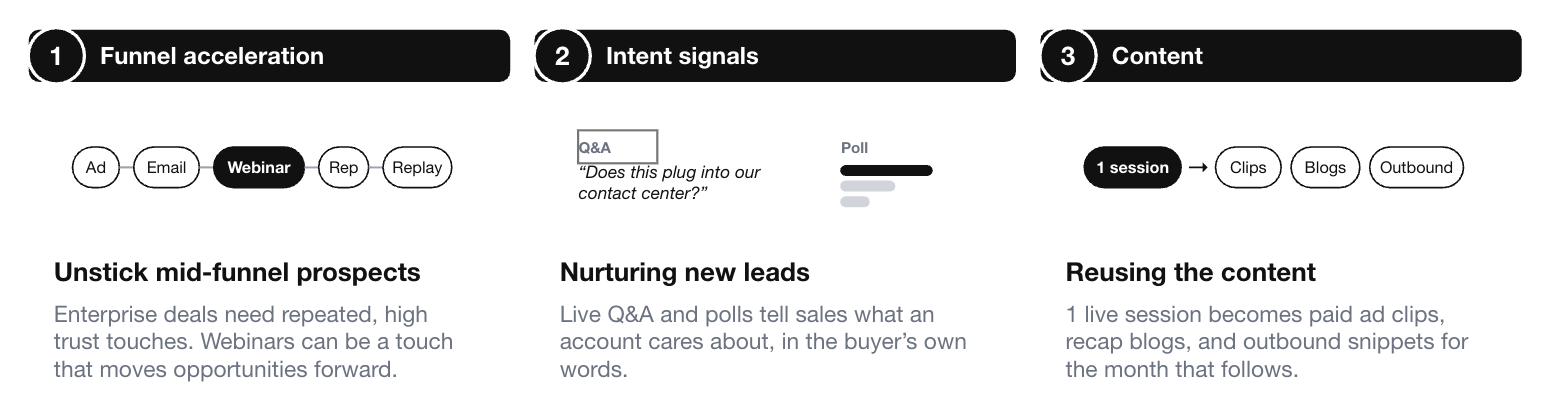
Before any automation, Raman gets clear on what a webinar is supposed to do for the business. In his model, every session does three jobs at once, and each one feeds the next:
- It moves prospects & open deals forward. Enterprise deals need repeated, high-trust touches. A webinar slots in between an ad, an email and a rep call, and gives an open opportunity a reason to move.
- It tells sales what buyers care about, in their own words. A Q&A question like "Does this plug into our contact center?" or a poll answer tells a rep more than a form fill ever will, and it shapes the next conversation on that deal.
- It feeds the next month of content. The same session becomes paid ad clips, recap blogs and outbound snippets, and the questions buyers asked point to which moments are worth clipping.
Run together, the three jobs compound. The content brings the next audience in, the session moves the deals that show up, and the signals tell sales and marketing where to go next.
That loop runs on data, and live engagement is only part of it. ElevenLabs embeds its webinars directly on its own website with Sequel, so registration, the live session and the replay all happen on an ElevenLabs page. Questions, polls and chat are tied to a known registrant and account, and so is everything around them: where someone came from, what else they read on the site before and after, whether they came back for the replay, and how it all lines up with their account in Salesforce. That's first-party data ElevenLabs owns, and it shows the whole buyer journey around an event instead of only the time it was live.
Tip for marketers: Plan every webinar for all three jobs before you lock the topic. Ask which open deals it can move, which questions you want buyers to answer for sales, and which clips and posts it will feed afterward. If a topic can't do all three, rework it before you promote it.
The Strategy: Four Series, One Funnel
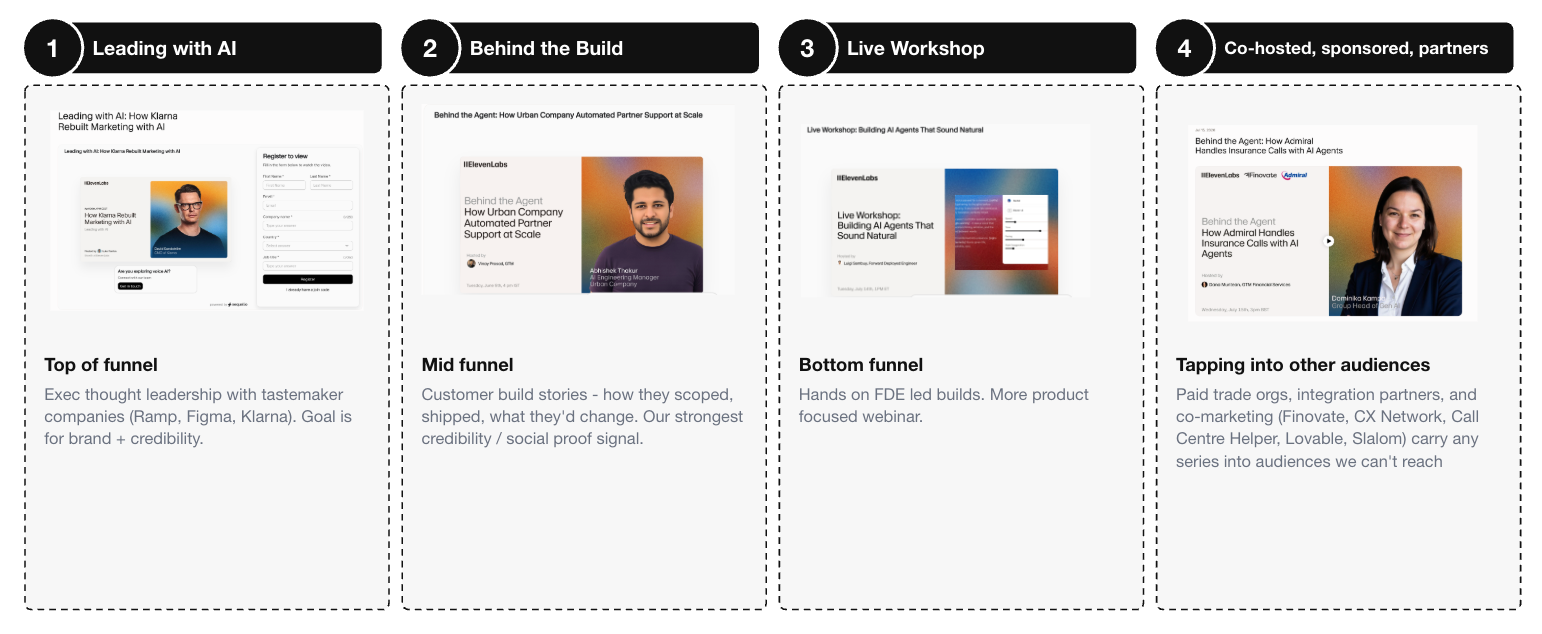
ElevenLabs doesn't run one webinar program. It runs four, each mapped to a stage.
- Leading with AI (top of funnel). Exec thought leadership with tastemaker companies like Ramp, Figma and Klarna. The goal is brand and credibility.
- Behind the Build (mid funnel). Customer build stories: how they scoped it, shipped it and what they'd change. Raman calls this their strongest social proof.
- Live Workshops (bottom funnel). Hands-on builds led by forward-deployed engineers. The most product-focused of the four.
- Co-hosted, sponsored and partner sessions. Trade orgs, integration partners and co-marketing (Finovate, CX Network, Call Centre Helper, Lovable, Slalom) carry any series into audiences ElevenLabs can't reach on its own.
Regional marketing leads can self-serve into this structure, picking a series and running it for their market on the same automations. That's how the team gets to 5 to 10 events a month without a matching headcount.
Tip for marketers: Name your series and tie each one to a funnel stage. It makes topic selection, promotion and reporting repeatable, and it's what lets other teams plug in without asking you to rebuild everything.
The Playbook: Inside the Agentic Engine
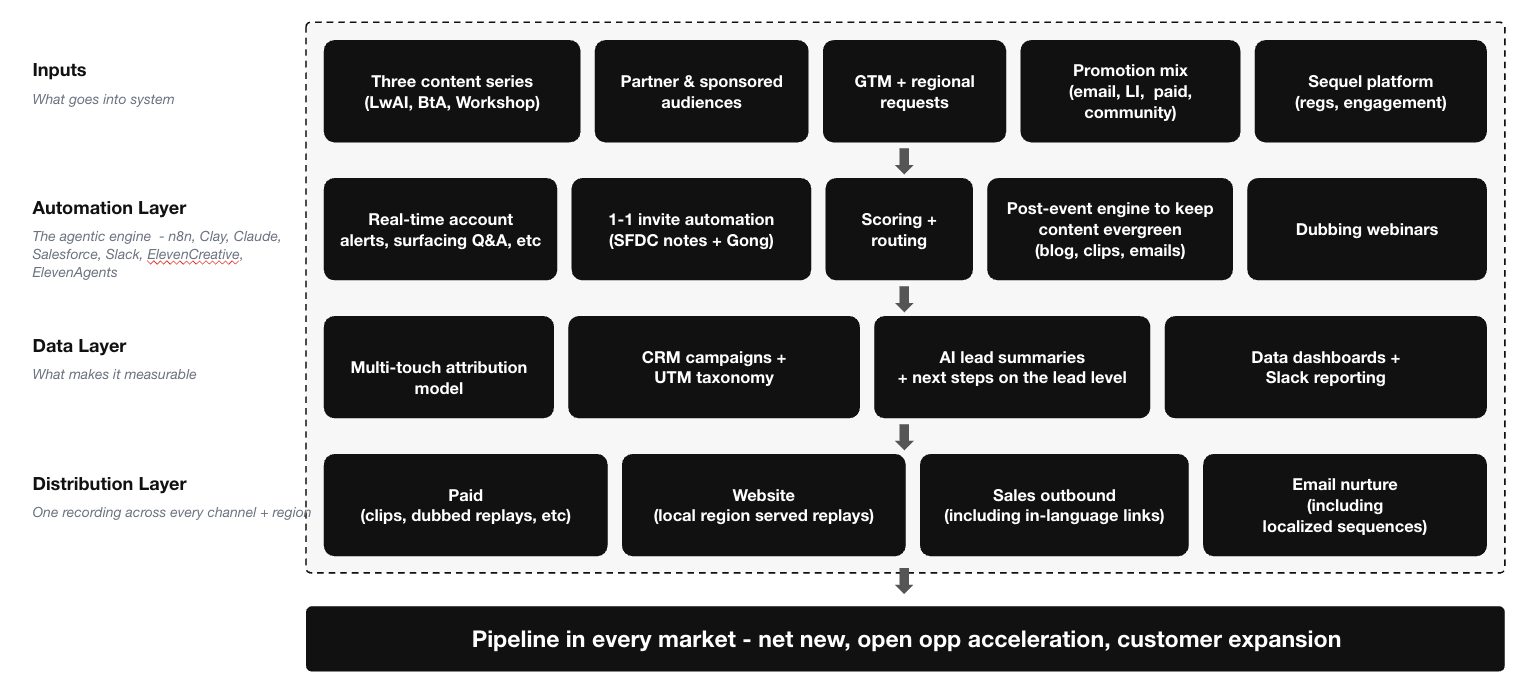
Raman's system has four layers. Inputs (the series, partner audiences, regional requests, the promo mix and Sequel's registration and engagement data) feed an automation layer built on n8n, Clay, Sequel, Salesforce, Slack and ElevenLabs' own agents. A data layer makes it measurable, and a distribution layer pushes one recording into every channel and region. Here's how a single webinar moves through it.
1. Know who's coming: real-time account alerts
Every registration for an ElevenLabs webinar comes through Sequel on the ElevenLabs website, so each new registrant arrives as a known contact the automation can check against Salesforce right away. If that person belongs to a named account, an open opportunity or a current customer, the AE or CSM who owns the account gets a Slack alert within moments of the sign-up. The flow started in Clay and has moved to n8n.
That timing changes what a rep can do with it. Instead of finding out who attended a week after the event, the rep knows who's coming before the session starts. They can send a quick personal note, invite a colleague from the same buying group, or give the speaker a heads-up so the session speaks to what that buyer cares about.
The alerts keep going once the event is live. When someone from one of those accounts asks a question, the same flow surfaces it to the account owner, so the follow-up starts from that buyer's own words.
Tip for marketers: Start with three alert triggers: named accounts, open opps and customers. Those are the registrants a rep will act on today, and anything more turns into Slack noise.
2. Let the CRM build the invite list: the two-week invite bot
Two weeks before each event, an automation looks across every rep's accounts and reads two sources: the notes in Salesforce and the transcripts of recent Gong calls. It matches what those buyers have been talking about against the webinar topic, picks the 15 to 25 accounts most likely to care, and hands each rep that list with a suggested invite already written. Four days later, it runs again. The team calls these checkpoints T-14 and T-10, shorthand for 14 and 10 days before the event.
The day before the event, a separate check-in bot posts an account overview and the run-through checklist, so the speaker and the sales team walk in knowing who's in the room.
Tip for marketers: Personal invites from reps outperform another promo email, but reps won't build the list. Hand it to them, topic-matched and pre-written, and the ask drops to one click.
3. Turn one session into a month of content: the clip flow
The repurposing starts the moment the live session ends in Sequel. The recording is ready, the replay flips on-demand immediately on the same page on the ElevenLabs site, and a Slack notification kicks off the content workflow in n8n. Nobody has to export a file or remember to start it.
From there, the flow runs in order:
- Transcribe. ElevenLabs Scribe turns the recording into a timestamped transcript.
- Draft the recap. The transcript becomes a first draft of the recap blog.
- Pick the moments. A prompt reads the transcript and selects the strongest moments for clips.
- Cut and render. Shotstack, a video editing API, cuts those moments into clips sized for LinkedIn, Meta and paid ads. It only ever touches the video, never customer data.
- Hand off. Drafts and clips land with the team for review, and the paid team can pull new clips from the same flow whenever it needs them.
That's how one hour becomes a month of content. The clips run as paid ads and speaker posts, the recap goes up as a blog, and snippets feed sales outbound and nurture emails in the weeks that follow. Every piece points back to the replay on the ElevenLabs site, so the people it reaches keep watching on a page Sequel already tracks, and each return visit adds to the same first-party record.
Tip for marketers: Let the prompt shortlist the moments, and keep a person choosing which clip runs as an ad. The cutting is busywork. Picking the hook is taste.
4. Brief sales the same day: scoring, lead summaries and follow-up
By the end of the day, every lead is scored and routed, and carries an AI-written summary of what that person actually did (sessions attended, questions asked, polls answered, watch time) plus a suggested next step. Reps get a briefing on who showed up, what they asked and which accounts to move on. Follow-up emails are drafted from the transcript the same day, and a human reviews every one before it sends.
That summary is only as good as the data behind it, and the live session is one slice of it. Because ElevenLabs hosts its webinars on its own website with Sequel, every attendee's record covers the whole journey: how they found the event, which pages they viewed before registering, what they asked and answered live, whether they came back for the replay, and what else they read on the site in the days after. It also connects across sessions, so someone who has attended three webinars this quarter looks different from a first-timer.
This intelligence then rolls that activity up to the company. Instead of one name on one day, a rep sees every person from an account who has engaged, which topics they keep coming back to and whether interest is building. All of it syncs to Salesforce, so the agents writing summaries and follow-ups start from what an account has actually done across the site.
The newest piece is a feedback agent: a voice agent embedded in the follow-up email that asks attendees what they thought.
Tip for marketers: Put the summary on the lead record itself. Reps live in the CRM, and if the context is there when they open the lead, they use it.
5. Go global: dubbing, local sessions and clean attribution
For most teams, a webinar only reaches people who speak the language it was recorded in. ElevenLabs treats every strong session as something that can run in every market it sells into, and it gets there three ways:
- A translated experience. The registration and event experience are translated for each market.
- Live local-language webinars. Regional teams run sessions in their own markets, on the same series and automations as the global program.
- Dubbed replays. The best-performing sessions are dubbed into regional languages, starting with Hindi, so one strong recording can run everywhere.
Dubbing runs on ElevenLabs, which carries each speaker's own voice into the new language, and a network of contractors reviews quality before anything ships. The result sounds like the speaker presenting in Hindi.
Any team can do this now. Sequel's global experiences have ElevenLabs dubbing built in, so every Sequel customer can turn a webinar into other languages automatically, without a separate dubbing tool, vendor or workflow. The dubbed versions live on your own site alongside the original, with the same registration, engagement tracking and CRM sync.
Once a replay is dubbed, it flows back through n8n into localized social clips, and the paid team can cut new in-language clips from the long-form video on its own. From there, one recording reaches every channel in every region:
- Paid: dubbed replays and in-language clips
- Website: the dubbed version served automatically based on the visitor's browser language
- Sales outbound: in-language replay links reps can send to accounts in each region
- Email nurture: localized sequences built around localized webinars
Each regional version runs through its own Salesforce campaign, backed by a UTM taxonomy and a multi-touch attribution model, so pipeline in a new market traces back to the replay that started it. Because every language version lives on the ElevenLabs site, Sequel captures the same first-party engagement in Hindi as it does in English: who watched, for how long and what they did next.
That's the payoff. A session recorded once can show up in a rep's in-language outreach in India, a localized nurture email and a regional paid campaign, all tied back to one recording. ElevenLabs gets pipeline from new markets without producing a new event for each one.
Tip for marketers: Dub your best-performing session first. You already know it converts, and localization opens a new audience for it.
Where the Humans Stay
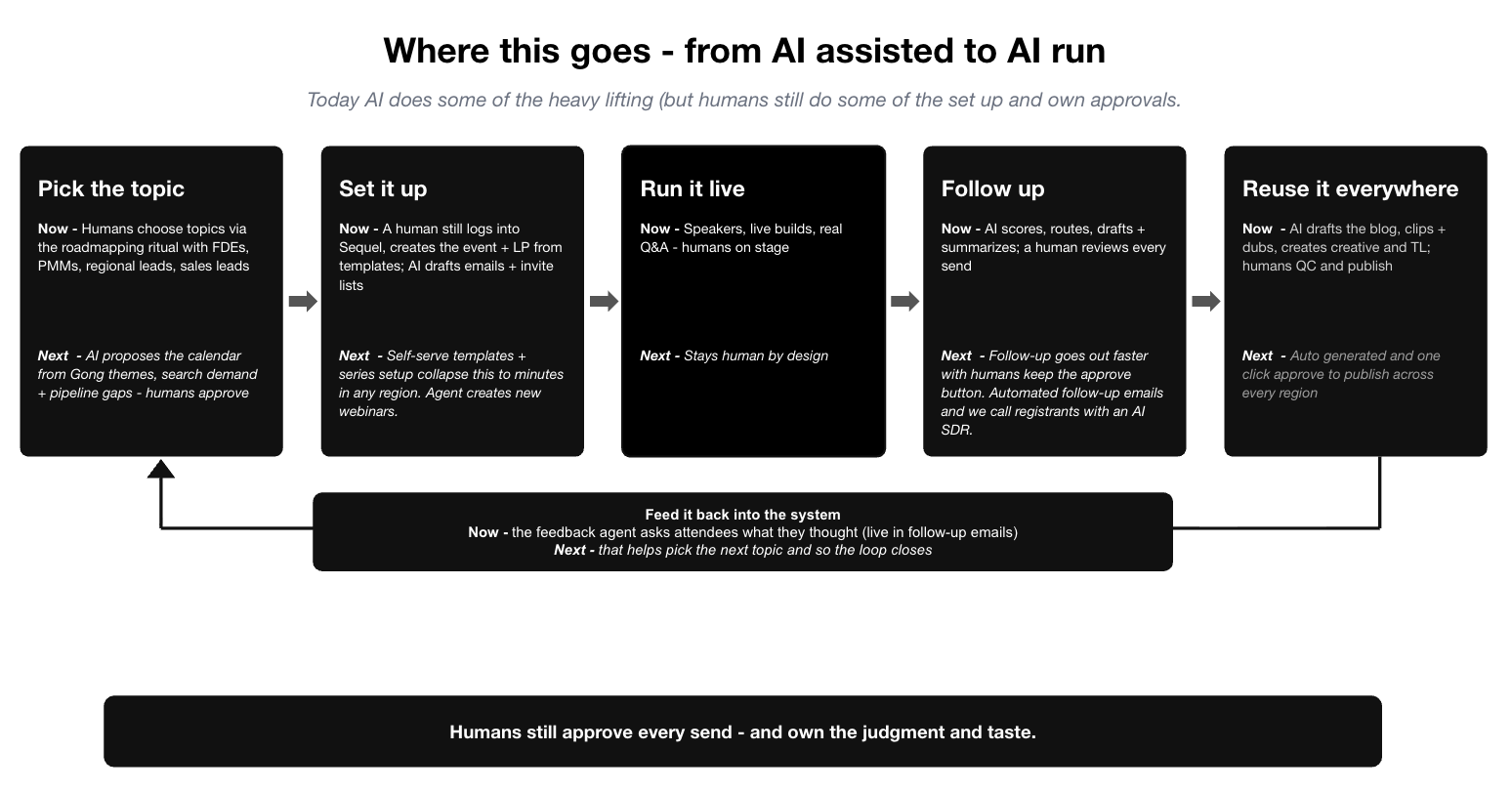
Raman is careful to call the engine AI-assisted today, with AI-run as the goal. People still own topics, approvals and anything that happens on stage. Here's how he maps it:
- Pick the topic. Now: humans choose in a roadmapping ritual with FDEs, PMMs, regional and sales leads. Next: AI proposes the calendar from Gong themes, search demand and pipeline gaps, and humans approve.
- Set it up. Now: a person creates the event and landing page in Sequel from templates, and AI drafts emails and invite lists. Next: self-serve templates and series setup take minutes in any region, and an agent creates new webinars.
- Run it live. Speakers, live builds and real Q&A. This stays human by design.
- Follow up. Now: AI scores, routes, drafts and summarizes, and a human reviews every send. Next: faster follow-up and an AI SDR calling registrants, with humans keeping the approve button.
- Reuse it. Now: AI drafts the blog, clips, dubs and creative, and humans QC and publish. Next: auto-generated, with one-click approval across every region.
- Feed it back. Now: the feedback agent asks attendees what they thought. Next: those answers help pick the next topic, closing the loop.
The live step is the point of the whole system. Every hour the agents save goes back into the exec guests, the engineers building on camera and the Q&A, the moments Raman says actually create pipeline. It's the Rubens workshop again: the apprentices handle the drapery so the master has time for the faces.
Tip for marketers: Before you automate a step, decide who keeps the approve button. Raman's rule is simple: humans approve every send and own the judgment and taste.
The Results
In six months, the program went from a $300K goal to a core pipeline channel:
- $14M in attributed pipeline in H1
- $300K pipeline goal at the start of the year, beaten by more than 45x
- ~$85M in pipeline touched along the way
- 5 to 10 webinars a month, plus regional and vertical sessions
Raman tracks three things: attributed pipeline, acceleration on open opportunities and distribution across target accounts. The pipeline number gets the headlines. The acceleration number is the one that ties webinars to deals already in motion.
Replicating ElevenLabs' Agentic Webinar Playbook
- Map every series to a funnel stage. Top for credibility, mid for proof, bottom for product, partners for reach.
- Automate around the event first. Account alerts, invite lists, clips and follow-up drafts are where the hours go. Leave the stage to people.
- Make the data complete before you add agents. Attendee-level questions, polls and watch time in your CRM are what make an AI summary or follow-up specific.
- Get one recording into every channel and language. Dub what already converts and give each region its own campaign so attribution stays clean.
- Keep a human on the approve button. Speed comes from drafts. Trust comes from review.
Raman's engine started with a $300K goal and a handful of automations. The lesson for anyone running webinars at scale is to give the busywork to the apprentices, so the room spends its hour with the master.
Want an engine like ElevenLabs' running behind your webinars? Find time with us to see how Sequel's engagement data, CRM sync and on-site experiences give your agents something real to work with.