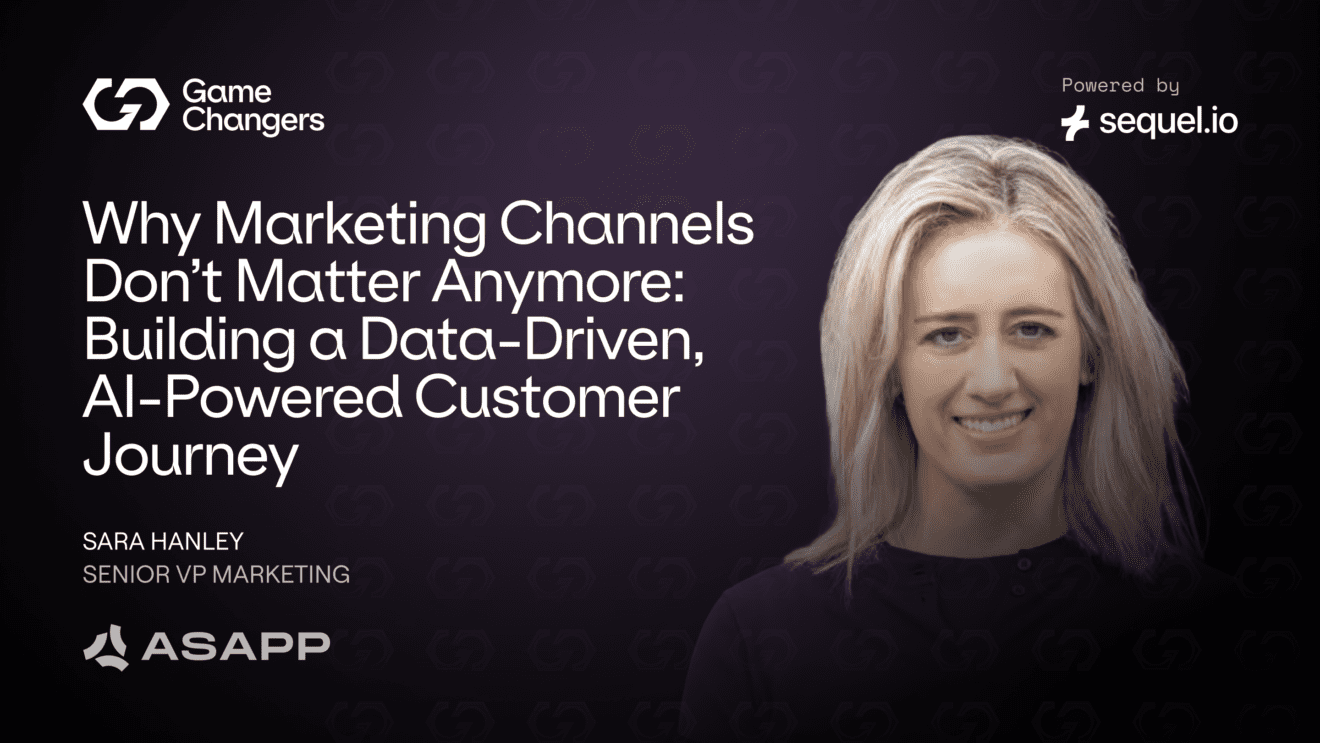
Why Marketing Channels Don’t Matter Anymore: Building a Data-Driven, AI-Powered Customer Journey
Senior marketers are moving beyond channel-based strategies toward fully orchestrated, data-driven customer journeys. In this session, Sara Hanley (Senior VP Marketing at ASAPP) shares how she built a growth engine from scratch; replacing gut-driven pipeline with operational rigor, leveraging AI as an agentic system, and rethinking everything from CRM to website experience. Expect a candid conversation on what it really takes to drive efficient, scalable growth in today’s AI-first marketing landscape.

Why Marketing Channels Don’t Matter Anymore: A Customer-Journey-First Playbook
Marketing teams still plan by channel, paid, events, lifecycle, web, partners, while buyers move fluidly across all of them. That mismatch is the real problem Sarah Hanley, SVP Marketing at ASAPP, set out to solve. Her central claim is not that channels are irrelevant, but that, channel-first thinking is an outdated operating model. The more durable advantage comes from designing the customer journey end to end, then using channels as instruments—not organizing principles.
Funnel rigor comes before growth acceleration
Hanley’s first point was foundational: you can’t scale demand into a funnel you don’t trust. Before increasing volume, she focused on tightening definitions, standardizing what qualifies as progress, and ensuring the system can absorb and convert quality accounts.
I can’t build you a growth engine if I don’t have a very clean and precise funnel.
The implication is that “more pipeline” is not a strategy if the machine is leaky. Journey orchestration, attribution modeling, and AI-enabled personalization only work when the handoffs and stages beneath them are crisp. Otherwise, marketing ends up optimizing noise, pushing activity into a process that cannot reliably translate interest into revenue.
Customer journey first, channel second
The heart of Hanley’s argument is that customers expect continuity. They don’t care whether a brand touchpoint is classified internally as “paid media” or “web” or “field marketing.” They care that the experience feels connected and that the brand demonstrates context.
Her goal, as she described it, is to be “channel agnostic where it’s customer journey first, marketing channel second.”
In practice, that means shifting planning from channel calendars to trust-building sequences. Instead of asking, “What are we doing in Q3 across channels?” the more effective question becomes, “What needs to happen—step by step—for a buying group to feel confident enough to engage in a sales conversation?” Channels then become interchangeable ways to deliver the next best interaction, rather than standalone programs competing for credit.
A better answer to “Which channel is working?
Oana raised the unavoidable executive question: leadership teams want to know what’s working, what to fund, and what to cut. Hanley’s answer was to keep the financial accountability, while changing the strategic lens.
That’s a great question, but it’s not the right question.
Her reframing is that boards often ask for a winner-take-all channel narrative when the reality is multi-touch: buyers develop confidence through a pattern of exposures, not a single moment. So rather than presenting only isolated channel performance, she looks for repeatable journey patterns—common paths that consistently precede pipeline creation. This approach still supports investment decisions, but it prevents the classic mistake of cutting “early touches” that don’t get last-click credit, only to see later-stage channels deteriorate.
It’s both: run channels like a P&L, but optimize via sequence and influence
Hanley is explicit that channels must be governed like a business. Spend requires discipline, and executives deserve clarity on unit economics.
Channels do cost money… I run those more like a P&L.
The key nuance is that financial management and growth strategy are related—but not identical. You can (and should) measure CAC payback and efficiency by channel, yet still acknowledge that channel performance is often the downstream result of upstream journey design. A paid program might “work” because the market has already been warmed through other touches; an event might “underperform” because the audience never received the right pre-education. When you optimize for the journey—not just the channel—you start investing in the *system* that produces conversion, rather than the single touchpoint that gets credited for it.
Agentic marketing: humans orchestrate AI to serve customers
Hanley described an agentic future where AI scales execution, but humans remain accountable for strategy, judgment, and truth.
Humans orchestrating the AI to then serve the customers.
The practical shift is operational: marketing leaders can’t treat AI as an add-on that simply “helps with content.” They need to design workflows where AI reliably produces on-brand, context-aware outputs, and where performance feedback loops are tight. The win isn’t automation for its own sake; it’s using AI to deliver more relevant experiences faster—without sacrificing quality or coherence across the journey.
Don’t outsource differentiation: original POV is non-negotiable
One of Hanley’s strongest cautions was about sameness. In an AI-saturated world, it’s easy to converge on generic language that sounds polished but says nothing.
You have to have an individual point of view… You need to sit with your own thoughts.
Her underlying point is that differentiation can’t be crowdsourced to models trained on everyone else’s messaging. The brand’s point of view has to come from real conviction, what you believe, what you’ve learned from customers, what you can prove. AI can help scale and adapt that message, but it can’t be the source of it. When it is, the result is the familiar “enterprise-grade, next-generation” sameness that buyers tune out instantly.
The website is evolving from a brochure to a guided conversation
Hanley also talked about the website’s role changing. The traditional “living brochure” model assumes visitors have time to explore, compare, and piece together meaning. Increasingly, they don’t.
Websites need to really evolve into being a living and breathing conversation piece, not just the brochure.
Her view is that modern sites should behave more like guided experiences: recognizing intent, adapting to context, and helping buyers get to clarity faster. The website becomes an active participant in the journey, not merely a repository of pages. This aligns naturally with journey-first thinking—because the site is often where fragmented touchpoints either become a coherent narrative or fall apart.
ASAPP’s direction: intent-based web experiences for MQAs
Hanley shared that ASAPP is exploring adaptive web experiences triggered by account-level intent, particularly when multiple people from the same target account show meaningful engagement.
An MQA, in her framing, is when “multiple individuals… have hit a threshold.”
That emphasis on account readiness reflects how enterprise buying actually works: committees, not individuals, create momentum. Designing experiences around MQAs also helps connect ABM signals to conversion moments on the site, turning “intent” into a tailored next step that accelerates a real sales conversation.
Closing: the new advantage is journey engineering
Hanley’s message lands because it’s pragmatic: keep channel discipline, but stop treating channel optimization as the strategy. The competitive edge now comes from **engineering the journey**—building a clean funnel, learning which touchpoint patterns build trust, using AI to scale relevance, and protecting a point of view that feels human and specific.
There’s just no playbook.
The teams that win will be the ones that design their own—around how buyers actually buy.