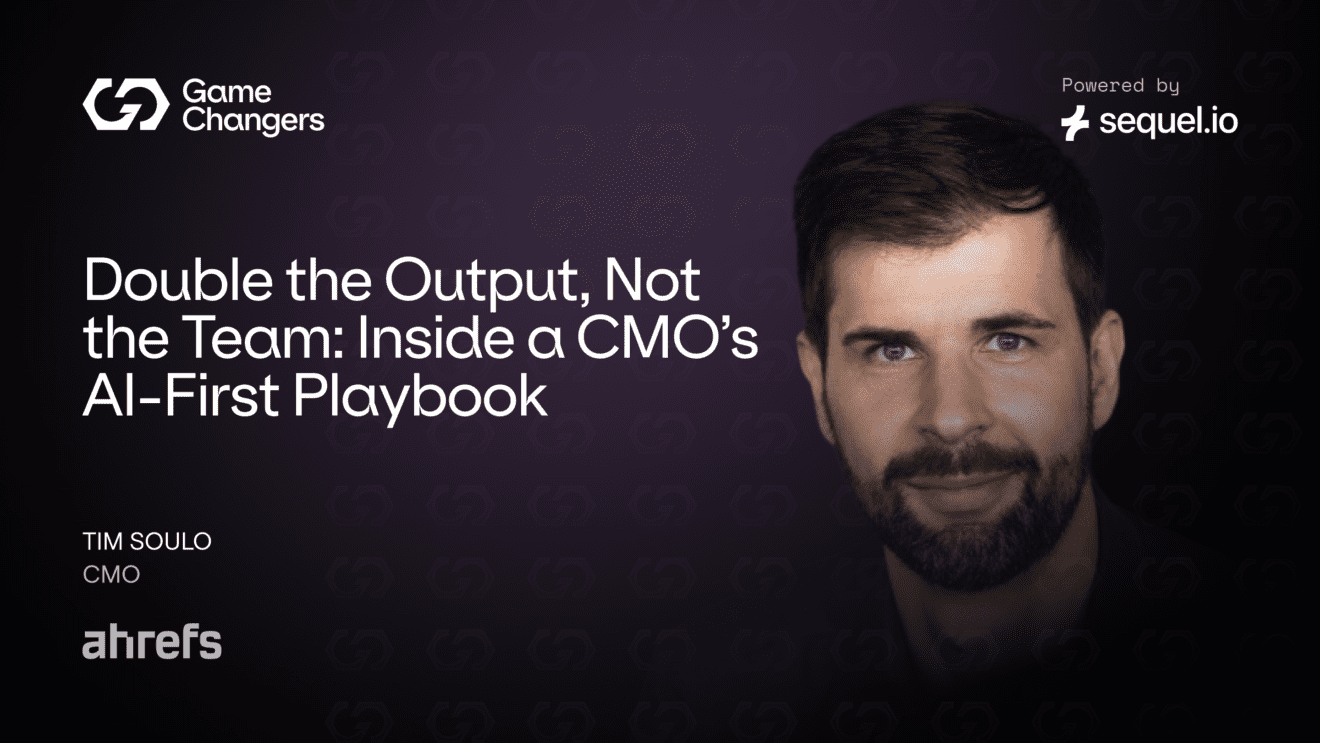
Double the Output, Not the Team: Inside a CMO’s AI-First Playbook
AI isn’t just another tool in the marketing stack, it’s becoming the operating system for how modern CMOs think, decide, and execute. In this session, Ahrefs CMO Tim Soulo breaks down how he’s using AI to double his team’s output, build internal agents, and rethink the role of marketing leadership entirely. From creating a “digital twin” of himself to redefining what marketers should spend their time on, Tim shares a candid look at what’s working, what’s changing, and what CMOs need to do now to stay relevant.

AI-Forward Marketing Leadership
In Sequel’s Game Changers CMO Series, host Kathleen Booth (VP of Marketing at Sequel) sits down with Tim Soulo, CMO at Ahrefs, to unpack what AI is actually changing inside modern marketing teams, beyond the hype. Soulo, who helped grow Ahrefs into a $100M+ ARR, bootstrapped business after joining as employee #16 in 2015, shares a candid view of his own skepticism, the turning points that changed his mind, and what real AI-enabled leverage looks like in a marketing org.
What stands out: Soulo isn’t just “using AI for content.” He’s building workflows, automations, and internal systems that change how he manages, decides, and executes, while also recognizing the constraints that don’t disappear just because AI exists.
Ahrefs in context: “Search” now includes AI search
Booth grounds the conversation by asking Soulo to define what Ahrefs is, because its product reality shapes its AI posture.
Ahrefs, Soulo explains, is a marketing platform focused on being discoverable in both traditional search and AI-driven search experiences:
Ahrefs is a marketing platform that mainly focuses on search, the conventional search and the AI search… built for marketers who want to be discoverable in search engines.
A key differentiator is their infrastructure moat:
We need to crawl the entire web… we have a copy of the web on our servers… only, like, a dozen companies in the world crawl the entire web.
This crawling capability underpins newer initiatives like Firehose—a stream-like system that detects mentions as the crawler discovers new pages.
You just give us a keyword, and as our crawler goes through the web… we give you this information.
From AI skeptic to builder: “I did a complete 180”
One of the most useful moments in the webinar is Soulo’s honesty about how recently his viewpoint changed.
Just slightly more than half a year ago, I was probably the biggest AI skeptic ever… fast forward six to eight months… I did a complete one eighty.
His message to leaders still unimpressed by earlier AI tooling: try again, because the capability curve is steep and recent.
Probably you tried it before. You weren’t impressed… so it’s time for you to do it again.
The “2x output” claim, then the nuance leaders need
Soulo had publicly said he expected marketing output to double with AI, but in this conversation he refines that expectation with a leadership reality check: humans are still the bottleneck in certain ways.
There’s a limit to a person’s mental capacity during the day… even though AI can help you… you just get tired.
So while “2x” may not be universally realistic:
One thing for sure, you can become more productive.
This is an important distinction for CMOs: the best AI strategy isn’t just “push for more volume,” but rather increase throughput while improving quality, especially by offloading low-leverage work.
The turning points: Lovable and Claude Code
Soulo identifies two specific moments that shifted AI from theory to practice.
1) Building a real app with Lovable
His CEO pushed him to use Lovable (despite resistance). Soulo chose a practical marketing ops problem: a dashboard to track team social posts and rank them fairly (accounting for follower size).
I was very, very reluctant… and surprisingly, I was able to build this with Lovable. And I was like, woah. This changes everything.
The unlock wasn’t “writing better prompts.” It was realizing marketers could build functional systems without traditional engineering skills:
Now all you need… is ideas, a vision… and ability to explain clearly what you want.
2) Moving to Claude Code for flexibility
A colleague pushed him toward Claude Code, and once it clicked, he began using it as a general-purpose “workbench.”
Right now, on my computer, I have a folder called Claude Code projects… some… applications… one… is a book that I’m writing together with Claude Code being my editor.
Booth mirrors the experience in a line that captures the emotional shift many marketing leaders feel once they connect AI to real execution:
It left me feeling… drunk with power… I don’t need to rely on an engineering team anymore for so many things.
Soulo reinforces the tradeoff: Claude Code can be “unlimited,” but it requires some setup that platforms like Lovable abstract away.
With Claude Code, you will have to figure out how to connect to GitHub, how to deploy… but… it walks you through everything step by step.
Why some teams don’t gain leverage from AI (even when they adopt it)
Booth references a common pattern: teams “use AI” but don’t see much improvement. Soulo names two blockers that show up inside real organizations.
1) Duplicate effort: everyone builds the same automations
When AI tools become available, people often solve the same “personal pain” repeatedly.
A lot of people… start working on the exact same things.
His concrete example: multiple writers independently building automations like “Google Docs → WordPress publishing.”
The implication for marketing leadership: AI leverage requires coordination, not just access.
You just need one person to build this skill, share it with others, teach them to use it.
2) Lack of imagination or reluctance to believe
Some people simply don’t try, either because they don’t see what’s possible or remain skeptical.
Some people are still skeptical… and other people are too optimistic… working on the things that someone has already built.
AI as a leadership system: “I forget less”
Where many leaders focus on AI for content output, Soulo points to something more strategic: AI as a management operating system.
First of all… I forget less. It’s literally I have a personal assistant.
He describes an internal workflow at Ahrefs where marketers post weekly plans in a Slack channel called OFT (repurposed from “out for today” to weekly intentions). Soulo built a Slack connector that:
- scrapes weekly plans
- categorizes them
- flags stalled projects (“posted the same thing for four weeks straight”)
- cross-references meeting notes transcribed by Granola
- and identifies misalignment between what was discussed and what’s being worked on.
He then runs this through Claude Code:
Load my team management project… check the latest messages… check the latest meetings… cross reference and tell me if you see anything that needs my attention.
This is an advanced but highly replicable model: AI as alignment and accountability infrastructure, not just a writing assistant.
Agentic marketing ops: why “cloud agents” change the game
Soulo also previews an Ahrefs initiative called Agent A (Agent Ahrefs): an always-on cloud agent connected to company systems (Slack, Notion, Linear, etc.), enabling scheduled workflows.
Cloud Code is running on your computer… as long as you close your computer, Cloud Code stops. Our Agent A would be running in the cloud.
The practical benefit: automation that runs without the human needing to remember to trigger it.
Repeat this workflow every Monday at 9AM and send me a DM on Slack with things that need my attention.
A high-value content workflow: AI-trained on your own voice
Soulo’s best “content” example isn’t generic AI copywriting. It’s a disciplined method for teaching AI to replicate his decision-making framework for LinkedIn posts announcing podcast episodes.
The workflow:
- Provide a podcast transcript + the LinkedIn post Soulo wrote about it
- Ask AI to infer the framework (“what mental framework did I go through?”)
- Repeat across multiple examples
- Correct the AI’s interpretation
- Turn it into a reusable “skill” (template + process)
- Iterate with feedback like you would train an intern
- Soulo emphasizes why this works:
Surprisingly, this skill would work very well because it is trained on your own work already.
And it eliminates a common bottleneck: writing posts weeks after recording, when the details are no longer fresh.
By the time I need to announce it… I no longer remember that well… I would need to re-listen… But AI writes those posts.
His analogy clarifies how leaders should think about implementation:
It’s literally like bringing some intern on board… and then it gets better and better every time you run it.
What changes in the CMO job? Less waiting, more testing
Booth asks whether AI changes the nature of CMO leadership. Soulo’s answer is subtle: the responsibilities are similar, but the cycle time collapses.
It’s still the same… It’s just… whenever I have ideas… I can suddenly try using Claude Code for that… I don’t need to wait for my ideas to get executed by someone.
The CMO becomes more of a rapid experimenter, able to prototype systems and workflows directly.
Hiring in an AI-forward org: still human-led, still growing
Despite automation gains, Ahrefs is still hiring (including product marketers and a social media manager). Soulo frames the “why” in terms of decision-making and accountability:
You still need people to make decisions. You still need people to hold accountable.
A pointed observation:
If you’re running AI agent, you cannot really keep them accountable for anything.
He also shares a compelling example of AI compression in production timelines: Ahrefs’ video team is releasing an “AI search optimization” course in ~1 month that previously would have taken 4–5 months, partly by automating interface demo creation.
Instead of manually recording every screencast… you can tell an agent, and it would create a video… without you needing to do it.
Practical takeaways for CMOs and marketing leaders
Re-test your skepticism. If your last evaluation was months ago, it may be obsolete.
Coordinate AI building. Without ownership, you’ll waste time duplicating “skills.”
Use AI for alignment, not just assets. Cross-referencing plans, meeting notes, and execution is a major leadership unlock.
Train AI on your prior work. The best outputs come from examples + iteration, not prompts alone.
Expect gains, but respect human bottlenecks. Output can rise, but decision fatigue is real.
Keep hiring, AI doesn’t replace accountability. Humans still own decisions, prioritization, and outcomes.