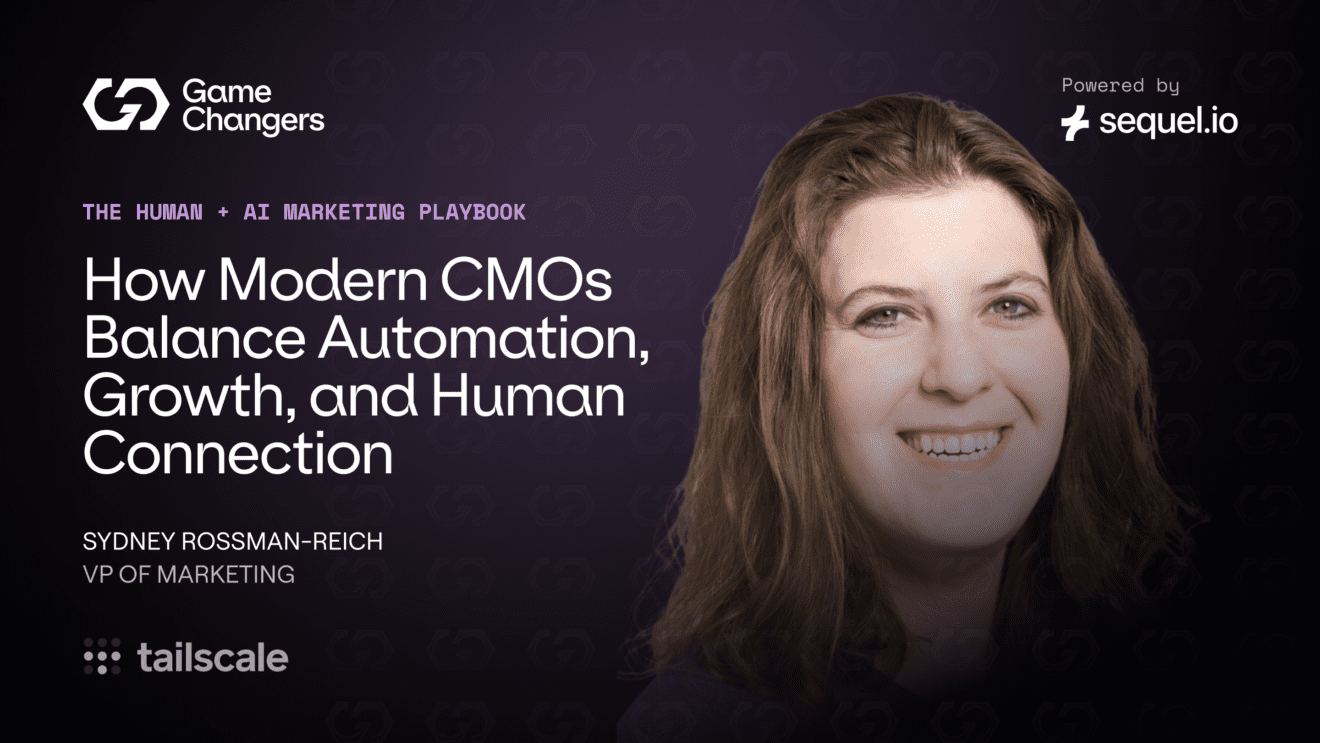
The Human + AI Marketing Playbook: How Modern CMOs Balance Automation, Growth, and Human Connection
AI is transforming marketing faster than any technology shift before it. From AI agents and automated workflows to hyper-personalized campaigns, today’s marketing teams can move faster and operate with fewer resources than ever.
But as automation accelerates, CMOs face a new challenge: where should AI lead and where do humans still matter most?
In this session, Sydney Rossman-Reich shares how she’s navigating this balance while scaling marketing in an AI-first world. From experimenting with new tools and workflows to rethinking team structure and the role of marketing ops, Sydney will break down what’s working, what’s still evolving, and how marketing leaders can embrace AI without losing the human creativity, judgment, and connection that drive great marketing.
Join this candid conversation on how modern CMOs are building marketing engines that combine AI efficiency with human insight to drive growth.

The Human + AI Marketing Playbook
AI has been marketed as everything from a copywriting machine to a strategy oracle. In reality, the teams getting the most value from it are the ones treating it as a force multiplier for human judgment, not a replacement for it.
That was the throughline in a recent Game Changers webinar hosted by Oana (Founder & CEO of Sequel.io), featuring Sydney, VP of Marketing at Tailscale. The session set out to answer a question many marketing leaders are wrestling with in 2026: how do you connect humans with AI in a way that improves both speed and quality, and what does a real playbook look like?
Oana opened by naming how unusual this moment feels for experienced marketers:
Marketing has changed so much in just past year… I personally don’t feel like has ever been such a huge shift in the way we’re working… than it’s been in the past year with AI and how to balance that.
From there, the discussion moved quickly into what matters: how to experiment without getting distracted, where AI is genuinely useful, and what must remain nonnegotiably human.
The hardest part isn’t adopting AI, it’s prioritizing amid overload
Most marketing teams aren’t short on AI options. They’re short on clarity about what will drive impact. Oana described the current landscape bluntly: constant noise, endless tools, and too many “must-try” tactics.
It’s getting to a point where there’s information overload… Every single time I open LinkedIn, there’s someone else doing something… and sometimes it’s hard to prioritize what’s really gonna make an impact versus… what’s interesting or just… hype.
That observation frames the first rule of an AI playbook: don’t treat AI as a goal. Treat it as a capability in service of outcomes. If a use case doesn’t tie back to revenue, pipeline, retention, category leadership, or customer understanding, it’s probably entertainment, not strategy.
Oana pushed the conversation into a decision leaders need to make explicitly:
Do you have some sort of… an approach on how you’re doing experimentation with AI versus what’s an actual strategy that you put… goals on KPI towards? Like, how do you decide?
Even without a rigid framework in the transcript, the prompt itself is instructive: teams should distinguish between experiments (time-boxed learning) and strategy (resourced programs with KPIs). Most AI efforts fail because they live in the middle, neither governed by a strategy nor structured as experiments.
Where AI starts paying off: continuous research and competitive monitoring
The webinar highlighted a high-ROI, low-ego use case: using AI to keep market context fresh. Instead of manual research sprints, teams can maintain an always-on competitive and news signal.
Oana shared a concrete example:
Our VP of marketing did exactly the same… for the kind of competitive… analysis on a weekly basis. We have it. And it’s so interesting.
This is the right kind of AI deployment for many organizations because it:
- reduces time spent gathering information,
- increases the cadence of learning,
- and creates a shared “truth feed” across marketing, product marketing, and leadership.
But the conversation didn’t stop at information gathering, which is where many teams plateau.
Close the “actionability gap”: information isn’t value until it changes decisions
Once you can generate insights quickly, the next question becomes operational: what do you do with them?
Oana captured the crux of the problem:
You can use AI to gather information. How do you take the next step and make the information actionable?
This is the gap most AI dashboards don’t solve. The fix is a workflow issue, not a tooling issue. To make AI “actionable,” marketing leaders need to assign each AI output to an owner and a downstream decision. For example:
Weekly competitive notes → update a battlecard, revise positioning, or arm sales with objection handling
Trend summaries → adjust the editorial calendar or add new campaign angles
Customer language synthesis → refresh website messaging, onboarding, and nurture sequences
In other words: AI can surface signals; humans must turn signals into moves.
Sydney’s nonnegotiable: AI output must begin with original human thought
The most definitive “playbook” moment in the session came when Oana asked where humans must stay involved:
What is nonnegotiable for you where humans have to have input? Like, they have to be involved.
Sydney’s answer is a standard that many teams would benefit from adopting formally:
Every AI output has to come like, it has to be generated from original thought and original content.
She drew a sharp line between outsourcing creativity and accelerating it:
It’s not just prompting AI being like, oh, give me five ideas for a campaign. It’s more about… going through your thought process and putting that in AI so that it can help you get there.
This is the difference between AI as generator and AI as amplifier. In Sydney’s model:
the human provides POV, constraints, and intent,
AI helps iterate, shape, and accelerate,
and the final work remains grounded in differentiated thinking.
Sydney also pointed out why this matters for brand distinctiveness:
In that case, obviously, not all marketing will sound the same because every human is different… So as long as it starts with… some original input and prompt, marketing can take so many different shapes as well.
In practical terms: if your team’s AI use begins with “give me five campaign ideas,” you’ll get what everyone else can get. If it begins with a customer insight, a strategic hypothesis, and a real point of view, you’ll get output that scales what’s already unique about your brand.
“We’re not there yet”: why humans still have to finish the work
The webinar also acknowledged a reality many leaders have discovered firsthand: even when AI helps, it rarely produces publish-ready work without human craft.
Oana shared her own experience building a voice model for LinkedIn content—then still needing to heavily edit:
I never ever posted a post that’s just been written by AI. I take it, and I edit it so much to a point I’m like, should I have just wrote this myself? Because it’s just… you have to finish things and make them sound human.
The point isn’t that AI is useless. It’s that AI accelerates drafting and iteration, while humans remain responsible for:
nuance,
credibility,
voice,
and the final quality, bar.
Sydney’s “original thought in” standard pairs naturally with a complementary “human finish” rule: AI can help you get to 70–85% faster, but your brand lives in the last 15%.
AI is changing hiring: less manual work, more leverage and new skills to screen for
A particularly forward-looking segment of the webinar explored how AI changes team structure and entry-level roles. Oana reflected on how earlier-career marketers used to spend most of their time:
Young people in the past were getting into roles that was a lot of manual work… I’m thinking about my first job… I would have wanted to do so much, but I was stuck in creating lists and doing research…
Then she contrasted that with what’s true now:
My cousin is 14 years old, and he’s using AI. So these young people are having AI in their curriculum. They’re using AI on a daily basis.
Her conclusion: the talent is still there, but leaders must recruit differently:
You have to search for different skills… in the interview process… versus… what we used to do in the past.
The implicit shift is from evaluating “can you grind through tasks?” to evaluating:
problem framing,
learning velocity,
judgment and taste,
and the ability to use AI to multiply output responsibly.
Productivity without paranoia: trust is the management unlock
As AI increases speed, some organizations respond by over-measuring activity. The webinar argued for the opposite: hire strong people, set clear outcomes, and trust professionals to use modern tools well.
Oana summarized that leadership posture:
Hiring the people not to kind of babysit them, but trusting that they are smart and professional, and they can… implement the things that helps them.
In an AI-enabled marketing org, “productivity” isn’t about surveillance—it’s about creating an environment where leverage turns into outcomes.
A publication-ready takeaway: the Sydney standard
If you pull one principle from the session and operationalize it across your team, make it Sydney’s:
Every AI output… has to be generated from original thought and original content.
It’s simple, enforceable, and protective of what matters most in marketing: differentiated thinking, authentic voice, and customer empathy.
AI can give marketing teams speed. But Sydney’s approach ensures they keep what they can’t afford to lose: originality, ownership, and the human layer that makes messages land.