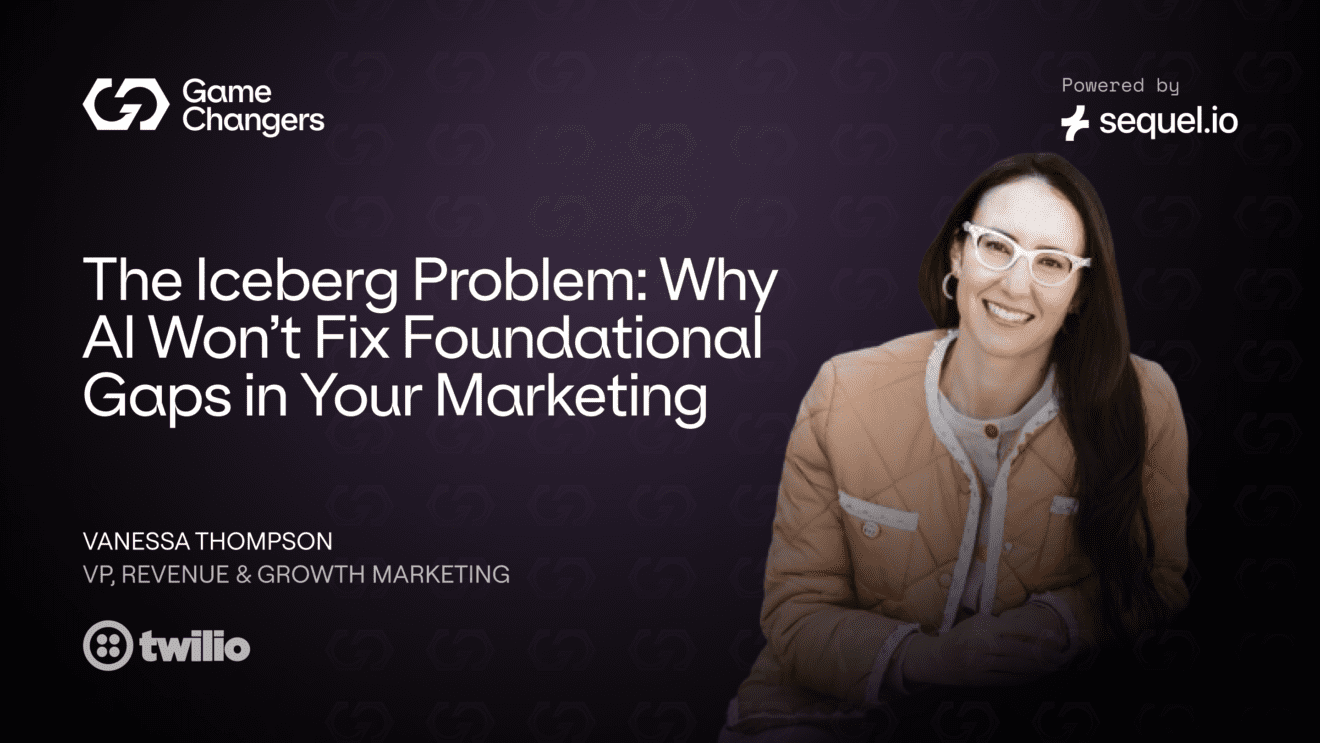
The Iceberg Problem: Why AI Won’t Fix Foundational Gaps in Your Marketing
AI isn’t just accelerating marketing, it’s exposing how much of our go-to-market motion is built on outdated assumptions.
In this session, Vanessa Thompson (Twilio) breaks down how modern marketing leaders are rethinking everything from lead scoring to campaign execution in a world where constraints are disappearing. Instead of layering AI onto legacy systems, the best teams are asking a more fundamental question: why does this process exist in the first place?
We’ll explore what it takes to challenge the status quo, redesign workflows from the ground up, and build a marketing organization that’s optimized for outcomes, not just efficiency.
Expect candid insights, real examples, and a fresh perspective on what it actually means to be “AI-driven” today.

Building an AI-Forward Marketing Organization
Marketing teams are in the middle of a structural shift: AI isn’t just speeding up workflows, it’s changing the constraints those workflows were designed around. In a recent *Game Changer CMO* episode hosted by Oana Manolache (Founder/CEO, Sequel.io), Vanessa Thompson (VP of Revenue & Growth Marketing, Twilio) shared a grounded, operator’s view of what it actually takes to build an AI-forward marketing org, one that moves faster, serves customers better, and isn’t trapped by legacy process.
Thompson’s perspective is rooted in scale: across nearly eight years at Twilio, she’s helped support growth from $600M to $4.5B in revenue, and (per the host intro) helped build an AI-first growth engine that produced $100M+ in pipeline in under a year. But her most valuable contribution is the reframing: the goal isn’t to “add AI” to the existing funnel, it’s to rethink the system.
The leadership traits that matter most in an AI-first era
Thompson’s career path (engineering, business, public sector, finance, analyst work) is a reminder that modern marketing leadership is less about “marketing pedigree” and more about adaptability. She emphasizes two capabilities: curiosity (to explore what’s changing) and a growth mindset (to keep evolving while the ground shifts).
One of her most practical leadership filters is clarity: if you can’t explain the strategy simply, you don’t understand it deeply enough.
If you have a fixed mindset and you wanna do things the way you’ve always done them, that is gonna be really challenging for you, especially in today’s landscape.
AI should change what you do, not just how fast you do it
A core message throughout the conversation: many marketing motions exist because humans historically couldn’t scale high-touch engagement. Campaign automation, nurture tracks, and scoring models are often “engineering solutions” to capacity limits.
AI agents change that equation. If an agent can engage every inbound lead or sign-up conversationally, you can revisit whether older proxy systems are still necessary, or whether they’re now adding friction.
All of the things that we do in marketing today are engineering solutions to human capacity problems.
The strategic implication is big: AI-forward marketing isn’t “same funnel, faster.” It’s a return to first principles, what does the customer need, and what’s the most direct way to deliver it?
Marketing’s finish line is customer success, not MQLs
Thompson describes a shift in marketing’s identity: the function is moving beyond pipeline mechanics toward helping customers achieve outcomes. In an AI-mediated journey, the lines between growth, lifecycle, enablement, and success blur, because AI makes ongoing, personalized assistance scalable.
Our job doesn’t stop and end at an MQL. It finishes when a customer is really successful on your product.
For teams, that means KPIs, workflows, and even org design start evolving toward longer-horizon impact: activation, adoption, expansion, retention, powered by better insight into what customers are trying to do.
Lead scoring is fading internally—but the ecosystem still depends on it
One of Thompson’s sharper points: once an AI agent is truly engaging every inbound motion, traditional lead scoring becomes less meaningful for internal routing and prioritization. The agent’s conversation (intent, sentiment, need, urgency) becomes a more direct signal than a point-based model.
However, she also highlights a real constraint: many ad platforms still rely on scoring-based signals for optimization. So even if scoring is obsolete internally, companies may need to keep it running as a compatibility layer, at least for now.
Now that we have an AI agent that talks to every single inbound lead and every sign up, I have no legitimate reason to score a lead.
The takeaway: AI transformation is partly technical—but also partially infrastructural. You’re modernizing in a world where external systems haven’t fully caught up.
Speed comes from redesigning workflow, not just adding AI tools
Thompson’s approach to increasing campaign velocity is a strong model for any marketing leader: don’t assume AI tools automatically equal speed. Instead, instrument the process, identify where work stalls, and remove “invisible bottlenecks”, the unwritten rules, unclear ownership, or approval loops that quietly slow everything down.
She describes pulling a high-performing campaign owner into a focused effort to map friction points and rebuild the workflow end-to-end. AI then becomes an accelerant *after* the system is cleaned up, helping with iteration, variation, and execution at scale.
It’s helped us identify invisible bottlenecks or unwritten rules that we were following that we didn’t know were actually getting ourselves in trouble.
Build a culture where teams can challenge the system safely
To keep teams evolving without creating constant friction, Thompson emphasizes structured experimentation and leadership support. She gives teams room to test ideas, even ones leadership might initially dismiss—then steps in when constraints require executive negotiation (cross-functional dependencies, tooling, governance, resources).
Hackathons are one mechanism she uses to institutionalize that behavior: give people autonomy to find problems worth solving, not just tasks to execute.
I do a periodic hackathon… I’m not gonna tell you what problems to solve.
AI adoption is also a people transition
Thompson is direct about an often-overlooked challenge: some roles, and reputations, have been built around specific tools and workflows. AI changes those workflows quickly, which can create anxiety or resistance if leaders treat the shift as purely operational.
She advocates meeting the moment with humanity: acknowledge identity risk, create space for learning, and redirect talent toward higher-value work (insights, strategy, creative direction, experimentation) rather than repetitive execution.
Some folks in your organization have careers built around tooling… it’s really important that you… approach it with humanity.
Buy vs. build: the integration tax is often the deciding factor
On whether to buy AI tools or build internally, Thompson points to a pragmatic determinant: integration complexity. When AI needs to connect deeply into internal systems and workflows, the “integration tax” can outweigh the speed of buying, pushing teams to build something native and modular that they can evolve over time.
When you get into the systemic execution… you have to hook up to all of your internal systems… That actually takes a huge amount of work and effort.
Closing: AI-forward marketing is a redesign, not a retrofit
Thompson’s overarching message is that AI changes the constraints, so the right response isn’t bolting AI onto yesterday’s playbook. It’s rethinking the engineered workarounds marketing has relied on for years, then rebuilding around what customers actually need and what modern systems now make possible.
Does it need to be this way?… Ultimately… what is it that we’re solving for?