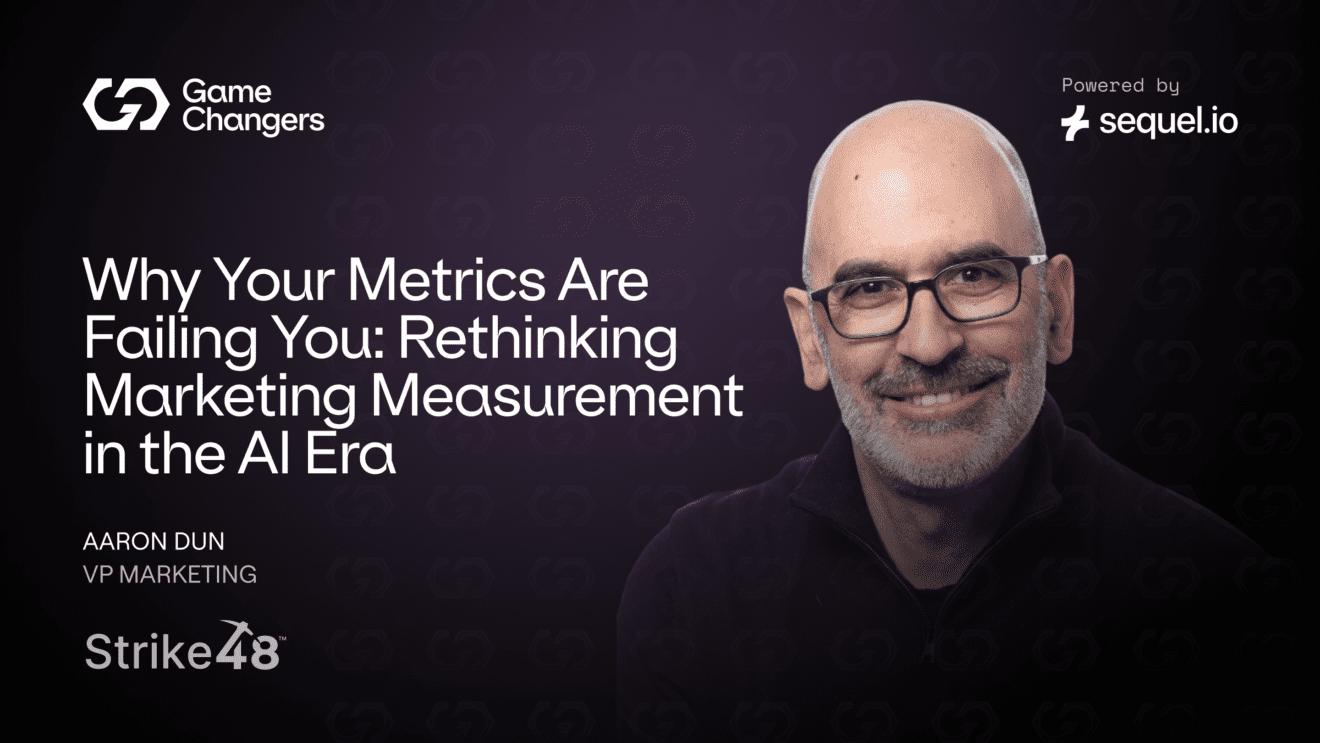
Why Your Metrics Are Failing You: Rethinking Marketing Measurement in the AI Era
Traditional marketing metrics, MQLs, attribution models, and funnel conversion rates, are no longer keeping up with how buyers actually make decisions.
In this session, Aaron Dun, VP Marketing at Strike48, shares a candid perspective on why the measurement model itself is broken, how AI is accelerating that shift, and what CMOs should focus on instead.
We’ll cover the rise of the dark funnel, the limitations of attribution, how discovery is moving off-platform, and why revenue, not activity, should be the north star. Expect strong opinions, real examples, and practical ways to rethink your GTM strategy for 2026 and beyond.

Marketing at AI Speed: Why the Old Funnel, MQLs, and Attribution Models Are Breaking
Key takeaways and quotes from the “Game Changer CMO Series” webinar with Aaron Dun, VP of Marketing at Strike48, hosted by Kathleen Booth (VP of Marketing, Sequel).
Marketing leaders have lived through major shifts, SEO, inbound, ABM, PLG. But the AI era is different in kind, not just degree. In this conversation, Kathleen Booth and Aaron Dun unpack what’s fundamentally changing, why common measurement frameworks (MQLs and attribution) are increasingly misaligned with reality, and what it takes to run a modern marketing team when the planning horizon compresses from quarters to weeks, and even days.
Below is an expert recap of the most actionable themes, supported by direct quotes from the session.
AI isn’t a “new label”, it’s a foundation-level reset
Booth frames prior marketing “movements” like inbound and ABM as mostly naming and systematizing things good marketers already did. Dun agrees, and argues AI is different because it forces a rethink of the underlying operating model.
Dun put it plainly:
This isn’t just like a, you know, a 25 degree tweak on the thing that we’ve always been doing before. This is… the opportunity really to reshape the foundation of… this world.
What makes it uniquely destabilizing is speed. Not only is change constant; the half-life of what you think you know is shrinking.
The pace of change… is leading towards a fundamental rethink of a lot of different aspects.
And the whiplash is real:
Right when you feel like you’ve got things figured out, it all changes.
“Pre-AI” vs. “post-AI” marketing: planning in weeks, shipping in days
Dun describes a practical shift in his own leadership: the organization can’t operate on quarterly planning as the primary unit of execution.
We don’t have years. We have months… we can’t be planning in quarters. We need to be planning weeks and executing in days.
The upside is equally dramatic: the cost and time to create high-quality assets has dropped, enabling faster experimentation.
We built v1 in a couple hours… [an asset] that would have taken us months.
Scale expectations are changing—“triple, triple, double…” is no longer the ceiling
Booth notes how growth benchmarks have shifted, and Dun expands: AI-era tools make outcomes that once seemed unrealistic feel plausible—if you hit product and distribution correctly.
The scale of what’s possible is dramatically different.
And:
If you get it right… you wanna play for hundreds of thousands, you gotta think things wildly differently.
The MQL model isn’t just “imperfect”, it’s misaligned with how buyers behave
The webinar’s sharpest critique lands on MQLs. Dun notes that the “death of the MQL” has been discussed for years, but AI and modern buying behavior make the gap harder to ignore.
He explains why MQLs worked historically:
The MQL… was built to justify… spend… [and] moves us marketers out of brand and arts and crafty field into more science and more rigor…
But the buyer journey that made MQLs useful has changed:
“People just don’t operate that way anymore.”
A content interaction often signals interest, not intent:
If they engage with your content, it’s because they like your content… But it doesn’t mean they’re in the market.
And the sales perspective is blunt:
Do your sellers want more MQLs? Not really. They want qualified people who are ready to buy…
Attribution is often about credit—not truth—and it can become organizational theater
Booth tees up a key insight: attribution can be more about distributing credit than deciding what works. Dun goes further, calling out how attribution meetings become a time sink.
“Attribution wars are brutal.”
He describes a weekly meeting dedicated to debating where opportunities “came from”:
I thought to myself, what a colossal waste of time.
Why does this happen? Because internal models often demand that each function “produces” a predetermined share of revenue.
Every time you justify their existence… it creates this really kinda strange dichotomy…
His warning is sharp: if marketing “hits” its model but the company doesn’t grow, celebrating is delusional.
You better not be the marketer… standing up and cheering… Because guess what? You failed.
What to measure instead: revenue, pipeline as a proxy, and ROI on a portfolio
Dun distinguishes between two measurement layers:
Team-level measurement (to understand what’s working):
We spent $100,000 on LinkedIn. What happened? … You should be measuring that…
Business-level measurement (what leadership should hold marketing accountable to):
The only number that matters is revenue… and pipeline… is the proxy…
He advocates for an investment mindset where marketing is judged on return—without micromanaging the channel mix:
If you’re gonna give me a million dollars… and I agree to deliver $3,000,000… hold me to that number. How I get there should be of no consequence…
This is his “holy grail”:
The business should not care how I get there.
The website’s role is changing as discovery moves “to the edge”
One of the most forward-looking parts of the discussion: Dun argues that classic web-centric measurement is breaking because discovery increasingly happens elsewhere—communities, dark social, and AI interfaces.
He notes:
Dark social is not new…
But what’s new is that even the “bedrock” of web measurement is eroding:
People aren’t clicking on your links in Google anymore. They’re actually just getting all the discovery they need… at the edge.
His provocation captures the tension leadership teams will face:
Website traffic is down 50% year on year, but business is up. What do you want me to do with that information?
Booth adds a complementary perspective: if people arrive more educated, websites must shift from being primarily educational to being experiential—interactive, personalized, and brand-building.
Operating at AI speed inside the marketing team: embrace chaos, impose intention
Dun is candid about what it feels like in practice:
First, I’m gonna say it’s absolute chaos.
Strike48 uses a lightweight sprint approach anchored on clarity of intent and cross-functional coordination:
The most important thing is for people on Monday to state intention about what I attempted to complete this week.
He also flags a common AI-era failure mode: shipping lots of v1 work that never gets finished or scaled.
It’s very easy to push a whole bunch of stuff live… they’re sort of… 75% done.
The discipline is returning to what works and investing in iteration:
That was always v1. Now we needed a v2.
He also shares a principle that underpins their agility:
Nothing is durable… we can change everything. And that’s the only… first principle.
Closing takeaway: Reset the narrative before you get forced into bad math
If there’s a unifying message, it’s this: many legacy marketing systems (MQLs, web-first attribution, rigid channel ROI reporting) were built for a world that no longer exists. You can either proactively renegotiate what matters—or get trapped defending proxies.
Dun’s advice when finance demands simplistic proof is to re-ground the conversation in real buying behavior:
Tell me about the last piece of software you bought. How did you learn about it?
That question, simple but disarming, is a powerful way to steer leadership away from false precision and toward decisions that reflect how customers actually discover, evaluate, and buy today.