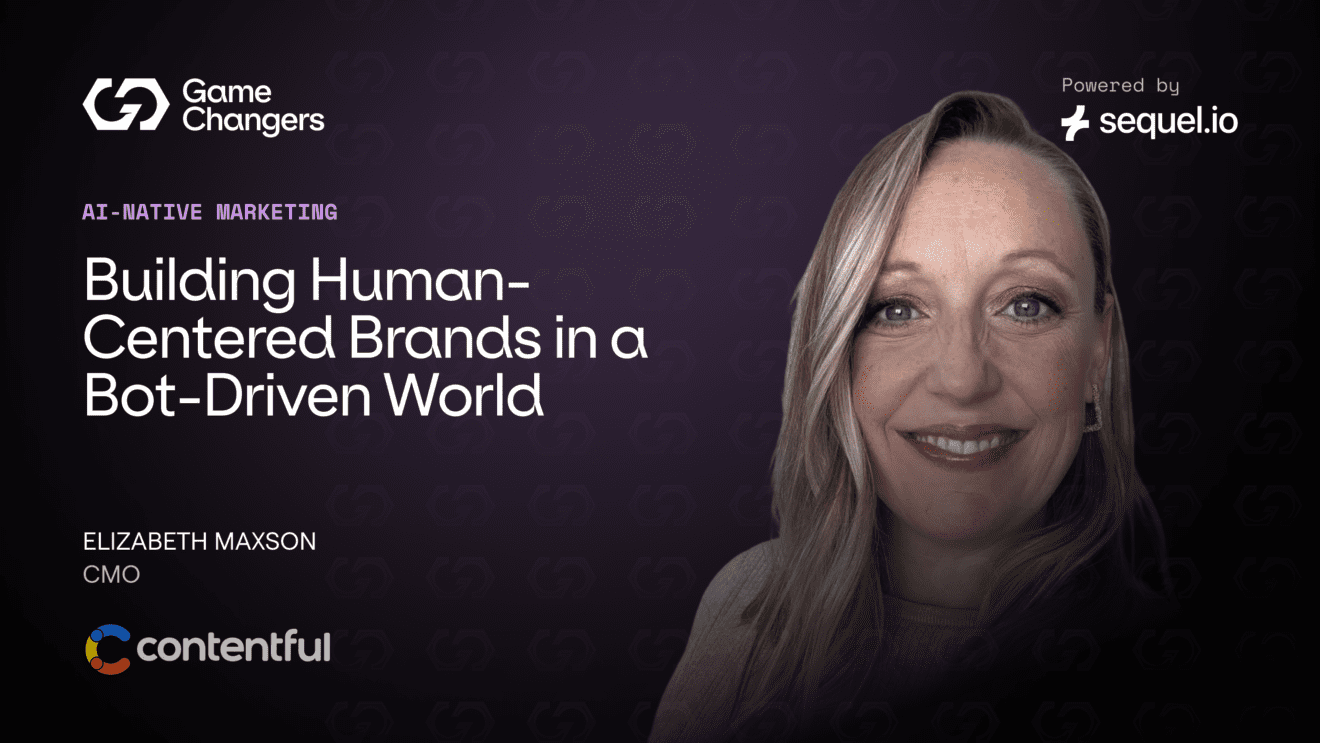
AI-Native Marketing: Building Human-Centered Brands in a Bot-Driven World
AI isn’t replacing marketers, it’s redefining what makes us valuable.
In this episode of The CMO Series, Elizabeth Maxson shares insights from her latest research and executive roundtables on how AI is transforming modern marketing organizations. Drawing from new data and her team’s own experimentation, she unpacks what it really means to become an AI-native marketing leader — and why the future belongs to brands that double down on being more human, not less.
From rethinking personalization beyond email to designing websites for both bots and humans, Elizabeth explores how marketing teams must evolve their talent, tech stacks, and content strategies to win in 2026 and beyond. She’ll also share how her team is a customer zero platform, what they’re changing about hiring and org design, and why the rise of bot traffic may force marketers to fundamentally rethink the purpose of their websites.
If you’re a CMO navigating AI adoption, team transformation, and the shift from B2B to B2H (business to human), this conversation will offer a practical perspective and a clear-eyed look at what’s next.

When Machines Make Marketers More Human
AI has moved from “nice-to-have” experimentation to a structural force reshaping how marketing teams plan, produce, distribute, and personalize. The real question now isn’t whether to adopt it, it’s how to use it in a way that increases both speed and distinctiveness.
In the Game Changers CMO Series from Sequel, Kathleen Booth spoke with Elizabeth Maxson, CMO of Contentful, about what that balance looks like in practice: where AI genuinely creates leverage, what guardrails matter, and how to keep the work rooted in human judgment.
The real unlock: “evidence-based creativity”
Maxson’s central idea is that the best marketing won’t be purely machine-generated or purely intuitive, it will be a combination of AI insight and human taste. She calls this evidence-based creativity: letting AI help with synthesis and iteration while humans bring context, lived experience, and decision-making.
We talk about this term, which is evidence-based creativity, and it’s the idea of combining AI-driven insight with your human judgment.
“AI-native” isn’t a title, it’s a culture (and guardrails)
Rather than chasing the label “AI-native,” Maxson argues that leaders should focus on building an AI culture: trusted tools, clear usage policies, shared education, and norms for verification. Without those guardrails, teams can scale the wrong outputs quickly, especially when AI draws from outdated internal sources.
How are you adopting AI that is safe and trusted? How are you ensuring that your teams are enabled and then educated?
Make AI learning visible: the “AI Playground” pattern
One of Contentful’s most effective internal moves was creating a shared space for experimentation, an “AI Playground” where people can post prompts, outputs, and what they learned. The point isn’t just prompt sharing; it’s turning AI adoption into an organizational habit, and surfacing where systems and data sources need improvement.
I decided to… launch a public channel in our company called AI Playground… throw in your prompt, throw out the output, was it good, was it bad, what did you learn from it.
AI increases self-sufficiency, but shouldn’t trigger internal turf wars
AI makes teams more self-serve: quicker drafts, lightweight creative mocks, faster iterations. But Maxson notes the organizational tension that can come with that: people worry that self-serve means certain functions become less necessary. Her view is that AI should reduce low-leverage dependency so specialists can focus on high-impact work.
Now I don’t need to ping you for mundane things… and you can be focused on the most strategic work.
Hiring shifts: soft skills become the differentiator
Maxson is adjusting how she hires in response to AI’s rapid evolution. Instead of over-indexing on hard skills or tool expertise, she’s prioritizing adaptability, curiosity, comfort with ambiguity, and the ability to learn fast. Those traits compound as workflows, tools, and expectations keep changing.
I’ve actually been focusing way more on soft skills than hard skills.
Stop “peanut butter spreading” AI, start with the problem you’re solving
Many teams start with scattered AI experiments and a growing list of use cases. Maxson’s advice is to mature past that quickly: begin with the business problem, speed, cost, conversion, pipeline, and then apply AI deliberately where it moves that metric. Adoption is not the goal; impact is.
I’m focused more on what is the problem that I want AI to solve, less… just use everything… peanut butter spread across my organization.
AEO/GEO reality check: quality beats volume
As discovery shifts and bots increasingly mediate what gets surfaced, summarized, and recommended, Maxson warns against the most common AI trap in marketing: using it to produce more content simply because you can. Her position is that quality and clarity care the winning inputs, not volume.
More content does not equal better content. Better content equals better content.
The website’s new mandate: personalization as the engagement engine
With LLMs absorbing more top-of-funnel education, Maxson sees the website’s job shifting toward engagement and conversion, especially through personalization. She challenges teams to bring the same personalization expectations they’ve long applied to email to the web experience, and to treat the homepage as a testable asset, not a sacred object.
Email… has been personalized forever… Why don’t you have that same expectation when you come to a website?
Human competitive advantage: B2H in a world of “AI slop”
When everything gets easier to generate, sameness becomes the default. Maxson argues that the best defense (and offense) is leaning into B2H: making marketing feel like it was built for a person, not for a segment label. That requires genuine understanding, a strong point of view, and experiences that earn trust.
In this AI world, everything is noisy. Everything sounds the same. It’s AI slop everywhere.
A practical experiment to watch: “abandoned chat” nurture
Maxon shared a concrete example of AI enabling new motions on the website: using an AI chatbot at scale to drive conversations, then testing an “abandoned chat” follow-up flow to re-engage buyers who drop off mid-conversation and route them back to a human when appropriate.
If you started a conversation and kinda left midway through, we’re now starting an email nurture program… to pick that back up and bring a human back into the loop.
What marketing leaders should take away
Maxson’s message is not that AI changes everything, it’s that it changes where marketing teams should spend their best human energy:
– Use AI to remove friction and accelerate iteration, then reinvest time in strategy and craft.
– Build a visible AI culture with guardrails, education, and shared learnings.
– Hire for adaptability and judgment, not tool familiarity.
– Resist the volume trap; prioritize quality as discovery becomes machine-mediated.
– Treat the website as an experimentation platform, and personalization as a growth lever.
– Differentiate through B2H: relevance, empathy, and human connection.
The teams that win won’t be the ones who automate the most. They’ll be the ones who use AI to create marketing that feels *more human*, not less.