The market looks different than it did six months ago. Cvent bought ON24 for $400 million in April 2026, right after acquiring Goldcast at the end of 2025, which means three platforms that used to compete with each other are now owned by the same company.
If you are evaluating livestreaming services right now, that matters, because pricing, product roadmaps, and the number of independent options all changed overnight.
Here are five platforms worth looking at, organized by what each one actually does well, and enriched with what we're hearing from the 570+ customer calls in our database.
Five Event Livestreaming Services Compared (B2B)
1. Sequel
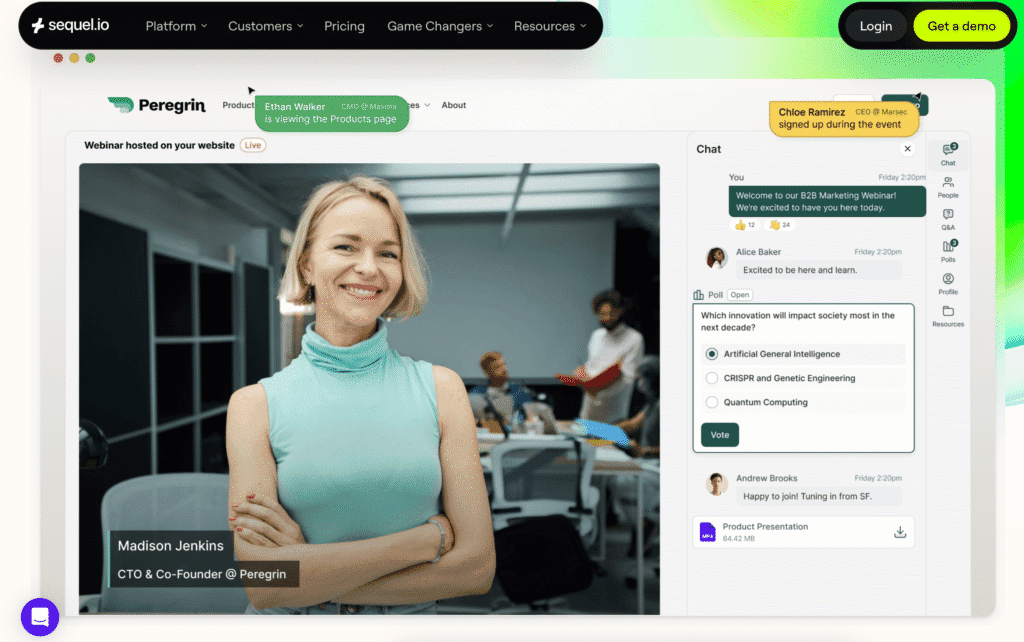
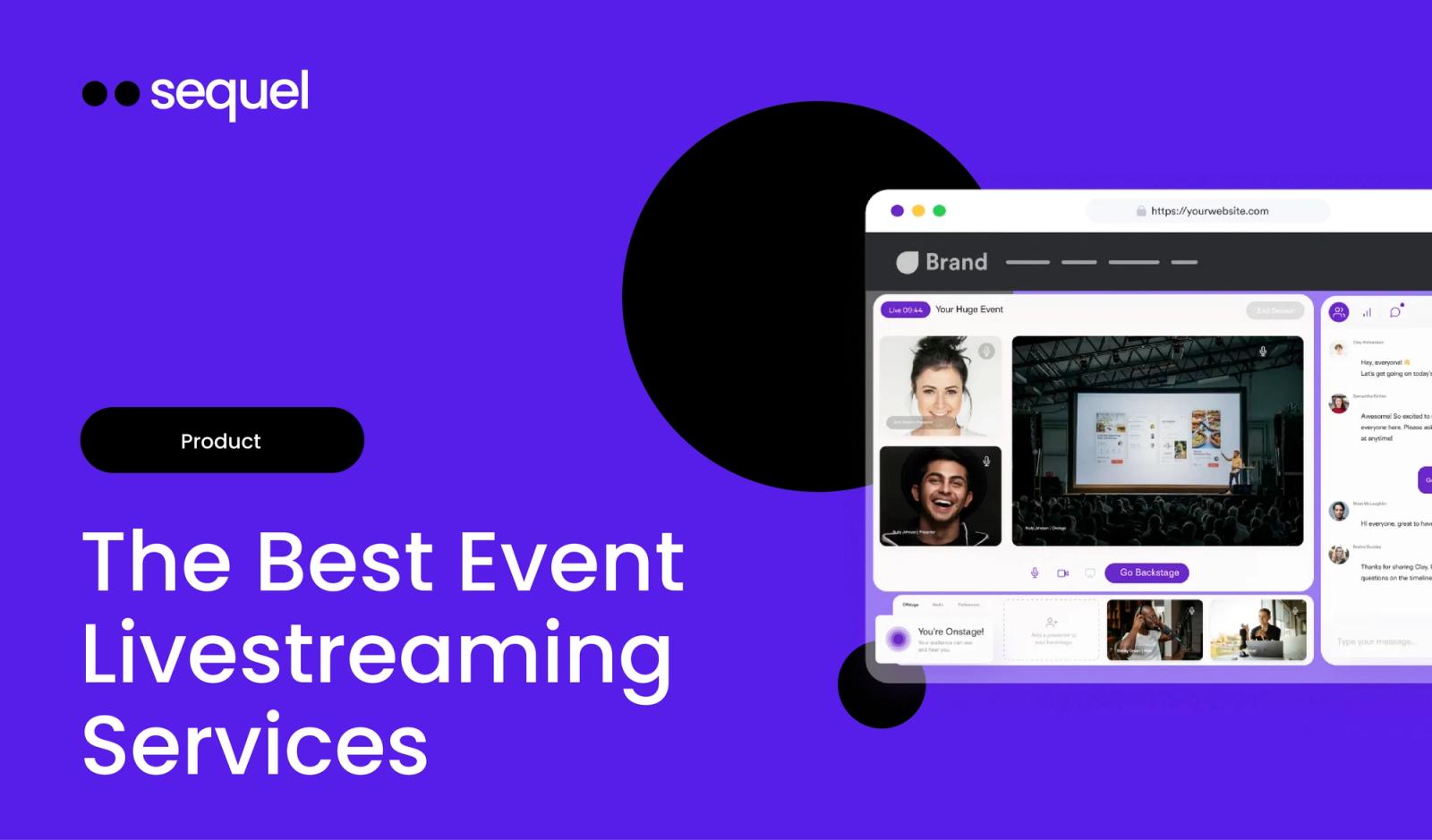
Sequel's whole premise is that your events should live on your website, not on someone else's platform. You embed the livestream directly on your domain with a no-code setup, so attendees never leave your site.
Registration data, engagement signals, replay views: all of it stays in your analytics.
That embedded model is the foundation of what Sequel calls the Intelligent Website. The idea is that webinars and live events are the highest-intent moments on your site. Someone who watches 45 minutes of a live session and asks two questions in the Q&A is telling you more about their interests than someone who bounces off a pricing page.
Sequel captures that signal and connects it to the rest of the visitor's journey.
Through Audience Insights, you can see what someone did before the event (which blog posts they read, which product pages they hit) and what they did after (did they visit pricing? download a case study? come back for the replay three days later?).
That full picture flows into HubSpot, Salesforce, or Marketo in real time, so sales gets context, not just a registration notification.
On the content side, Sequel AI Studio turns one live session into a set of reusable assets: clips, blog posts, social content, translated subtitles, even AI-dubbed multilingual versions of the recording. The on-demand replay publishes instantly after the session ends, so you capture replay viewers while the topic is still fresh. Over time, your webinar library becomes a permanent content layer on your site that keeps working long after the live event is over.
You also get live chat, polls, Q&A, networking circles, and the platform scales up to two million concurrent viewers.
What customers say about the embedded model:
One marketing lead evaluating Sequel described the problem with their previous platform: "We do the webinar and then we throw it on YouTube, but our YouTube audience only wants to watch three minutes of video. And then otherwise, we have the replays, but we're sending people off of our website. So then we don't control the next step of the funnel."
They saw Clay's webinars running on Sequel and assumed it was a third-party embed. When they realized Sequel handled everything natively, they started evaluating the switch.
A customer scaling up their webinar program said the move to Sequel was motivated by wanting "something we can rely on working" at scale, noting that their previous platform "worked well earlier on, but as we started to do more webinars, it was starting to get harder to use. There were a lot of bugs, and it didn't feel like it was doing what we needed it to do."
Customer results on Sequel:
- Apollo.io runs 8 webinars per week with a 500% increase in product adoption
- Sentry's developer workshop program found that 10% of their entire sales pipeline had at least one contact who engaged with the series, with a 58-59% engagement rate
- CaliberMind's webinar series influenced more than $4M in pipeline from 300+ unique attendees
- One customer reported a 42x ROI, generating $1.7M in pipeline from 2,000 hours of audience engagement
The trade-off is scope. Sequel is built for marketing and demand gen events, not in-person logistics. If you also need badge scanning, venue sourcing, and physical event management, you will pair Sequel with a separate tool for that.
See the platform or book a demo.
2. Cvent (now includes ON24 and Goldcast)
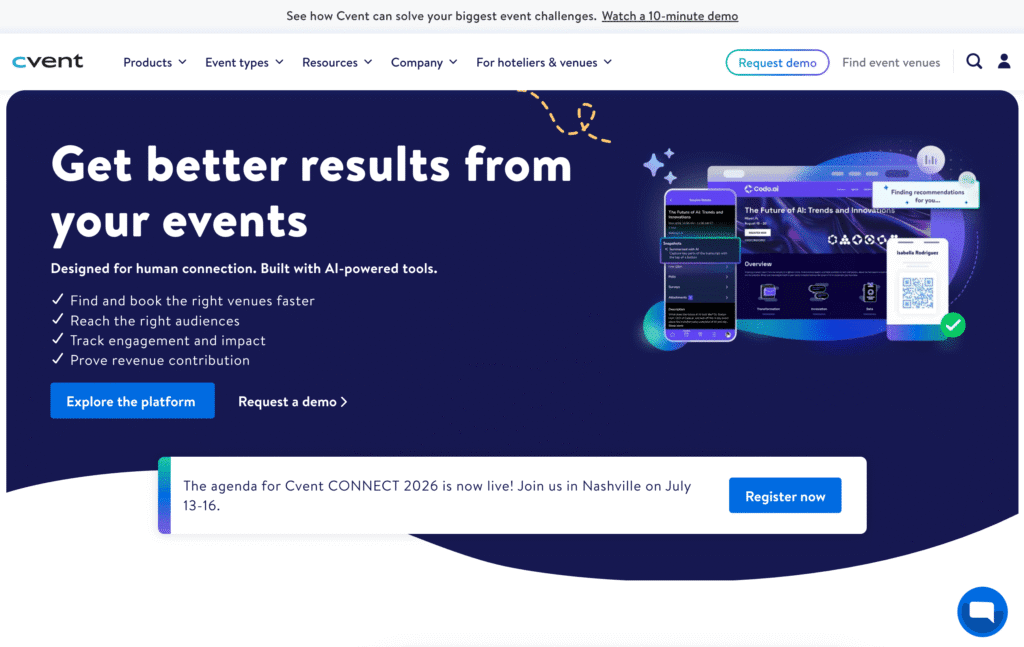
After the two acquisitions, Cvent has the widest portfolio in the market.
The core platform handles in-person event management: registration, venue sourcing, attendee tracking. ON24 adds webinar infrastructure with engagement scoring and lead analytics. Goldcast adds polished virtual event experiences and content repurposing workflows.
If you run a high volume of events across in-person, hybrid, and virtual formats and want one vendor for everything, Cvent is a popular option to evaluate.
The catch: the three products are still being stitched together.
What customers are saying about the acquisition:
The Cvent consolidation is the single most-discussed topic in our recent sales calls. Customers on both ON24 and Goldcast are evaluating alternatives, and the anxiety is consistent.
One customer described the pattern bluntly: "Once they got all those former customers on multi-year, then they said, well, now that product's going to be sunset."
Another customer currently on Goldcast noted: "Having gone through acquisitions before, you never know how it's going to shake out, or how they're going to marry the businesses."
A Goldcast customer described practical friction already showing up: they couldn't generate a single URL for ad campaigns, a feature that "wasn't possible in Goldcast." And they found Goldcast charged "a freaking buttload" for additional webinar credits beyond the base contract.
Multiple ON24 customers described the platform as "incredibly outdated" in terms of user experience, with integrations that were "ultra slow" and unreliable. (For a deeper dive, see our ON24 alternatives guide.)
If you are buying into Cvent in 2026, ask specific questions about which features live where, what the integration timeline looks like, and how pricing works across the combined portfolio.
This is also the most expensive option on the list, and existing ON24 or Goldcast customers should check whether their current experience is going to change as the products merge.
3. Bizzabo
Bizzabo covers virtual, hybrid, and in-person events in one platform. Where it stands out is the data layer.
Event data flows into your CRM and pipeline reporting, which makes it useful for teams that run a lot of different event types and want a single system of record tying them together.
It is more platform than point solution, though. If all you need is webinars or simple livestreaming, Bizzabo is probably heavier than what the job requires.
4. Livestorm
Livestorm is browser-based. Attendees click a link and they are in. No downloads, no app installs, no friction.
That makes it a strong pick for teams running frequent marketing webinars or product demos where the priority is getting people into the room quickly.
What customers switching from Livestorm say:
Livestorm is the third most-mentioned competitor in our call database, and the migration pattern is clear: teams start on Livestorm because it's simple, then outgrow it as their webinar program scales.
One customer described their motivation for exploring alternatives: "The current Livestorm website embed experience is terrible, and they realize it also." They were specifically interested in hosting webinars on their own domain rather than sending attendees to Livestorm's site.
Another customer switching from Livestorm noted that cross-event data and attendee tracking were simply not possible: "Livestorm does not have that data or that ability at all." The inability to connect engagement signals across events to a CRM pipeline was the primary driver for switching.
A customer scaling their webinar program from occasional to weekly said Livestorm "worked well earlier on, but as we started to do more webinars, it was starting to get harder to use. There were a lot of bugs." They moved to Sequel specifically because they needed "something we can rely on working" and wanted the website-embedded model and better data integration with Salesforce and HubSpot.
The flip side is that Livestorm is a webinar tool, not a full event platform. Complex conferences, hybrid setups, or anything requiring deep event operations will outgrow it. It also runs on Livestorm's domain, not yours, so you don't get the embedded-on-your-website model that Sequel offers.
Plus, they have limited options (at the time of writing) for video-based content repurposing and, like many other solutions on this list, the text-based repurposing doesn't go beyond an OpenAI API call (meaning you'd get the same result or less by using your own ChatGPT account).
For a side-by-side with Sequel, see our Livestorm alternatives page.
5. RingCentral Events
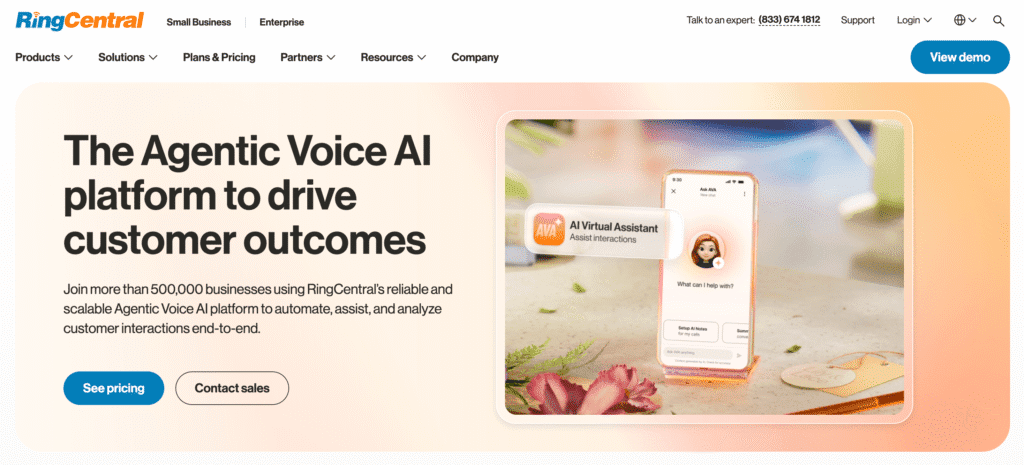
RingCentral Events (the platform formerly known as Hopin) is for big virtual conferences. Multi-track agendas, virtual expo halls, networking features, high attendee volumes.
If you are running a 5,000-person virtual conference with parallel sessions, this is the category it plays in.
What customers say about RingCentral:
RingCentral appears in our call data primarily in the context of integration complaints. One customer specifically flagged that their RingCentral integration "just hasn't been set up the way we need it to be set up," noting that "not all integrations are created equally."
It is not particularly marketing-native, though. If your goal is demand gen, content repurposing, or pipeline attribution, you will probably want something else. RingCentral Events is about logistics and scale, not lead scoring.
For background on how the platform got here, see our Hopin alternatives page.
What About WebEx Webinars?
WebEx is Cisco's webinar product, and it does what you would expect from Cisco: security, compliance, reliability, enterprise IT integration. It works well for corporate webinars, internal all-hands meetings, training sessions, and organizations that already run Cisco infrastructure.
One customer currently on WebEx described wanting to consolidate: "We have Webex, we have On24, we have Teams. Each of them have kind of their places, but we want to drop Webex." Another noted the file-sharing limitations: they could only share documents if hosts uploaded them in advance, with no way for presenters to share materials in real time during a session.
WebEx supports up to 100,000 attendees on enterprise plans and has decent presenter tools (immersive share, practice sessions, breakout rooms). But it is built for corporate use cases.
The branding options are limited, there are no content repurposing features, and the learning curve is steeper than simpler tools like Livestorm. If you are a B2B marketing team looking to run demand gen events, this probably is not for you.
Free Platforms: YouTube Live, Facebook Live, Twitch
All of these options are free. They give you access to large audiences. If you have never done a livestream before and want to test the format with zero risk, they work for that.
For anything beyond that, the limitations add up fast.
You cannot brand the experience. You cannot embed it on your website. There are no registration forms, so there is no lead capture. There are no CRM integrations.
And your attendees are one click away from cat videos.
For B2B teams, free platforms work best as distribution channels. Multistream your event to YouTube alongside your primary platform to grab extra reach, but do not make YouTube the primary platform.
What the Cvent Acquisitions Mean for Everyone Else
Three platforms under one roof is a big deal. A few things to think about depending on your situation.
If you are a current ON24 or Goldcast customer, Cvent says both products will keep running. That is probably true in the short term. Product roadmaps, though, will shift as the three platforms converge.
If you are coming up on a renewal, ask directly:
- Which features stay standalone?
- Which get folded into the Cvent core?
- What does pricing look like in year two?
If you are shopping for a new platform, the independent options just got shorter. Outside the Cvent umbrella, the main choices are Sequel, Bizzabo, Livestorm, and RingCentral Events. Each does something different.
Pick based on which problem you are actually solving.
Sequel and Cvent are heading in opposite directions philosophically. Cvent is building a sprawling all-in-one enterprise suite. Sequel is focused on embedded, website-native events where your data and branding stay under your control. Those are different bets, and which one fits depends on whether you value breadth or ownership.
Picking the Right One
Skip the generic feature checklist and start with what you are trying to do.
If brand control and first-party data are the priority, you want events on your own website. That is Sequel's model, and it gives you cleaner attribution than any third-party platform. See how Sentry and CaliberMind are using embedded events to influence millions in pipeline, or read the full-funnel webinar strategy guide for the complete playbook.
If you need enterprise event management across every format (in-person, hybrid, virtual), Cvent or Bizzabo can cover it. You will pay more and deal with more complexity, but you get one system.
For more on how livestreaming fits into the bigger picture, see our guides on virtual event planning, hybrid event management, and webinar setup.
Frequently Asked Questions
What Are Event Livestreaming Services?
Platforms that let you broadcast live video to a virtual audience with registration, engagement tools (chat, polls, Q&A), analytics, and recording. They handle the technical infrastructure so you can focus on content.
Which Platform Is Best for B2B Events?
Depends on what you need. Sequel for website-embedded branded events with full pipeline attribution. Cvent for a full enterprise suite covering in-person, hybrid, and virtual. Bizzabo for multi-format event management. Livestorm for simple recurring webinars with minimal setup.
How Did the Cvent Acquisitions Change Things?
Cvent bought Goldcast in late 2025 and ON24 for $400 million in April 2026. Three major platforms are now one company. That reduces independent options and creates uncertainty for current ON24 and Goldcast customers around pricing, product direction, and feature consolidation. Multiple customers in our database cited the acquisition as their primary trigger for evaluating alternatives.
Are Free Platforms Like YouTube Live Good Enough for B2B?
For getting started, sure. For actual B2B marketing, no. No registration, no branding, no analytics, no CRM sync. Use them as supplementary distribution channels alongside a real event platform.
What Features Actually Matter?
Reliable streaming (RTMP and CDN), engagement tools, registration with lead capture, analytics, CRM integration, and branding. After those basics, choose based on whether you need website embedding, hybrid support, conference scale, or simplicity.
Why Are Teams Switching Away From Livestorm?
The most common reasons in our customer data are the inability to host events on your own website (Livestorm events live on Livestorm's domain), limited cross-event attendee tracking, lack of reliable integrations at scale, and minimal content repurposing beyond basic text generation. Teams that outgrow Livestorm typically want better data flowing into their CRM and events that contribute directly to pipeline attribution.