CaliberMind’s Guide to Webinar ROI: Building a High-Substance Event Series That Influenced $4M+ in Pipeline
Most marketing teams do not struggle with producing webinars. They struggle with deciding what webinars are meant to accomplish.
In many organizations, webinars are treated as discrete execution units. Each one is planned, promoted, delivered, and evaluated largely on its own. Success is measured quickly, often narrowly, and the work resets almost immediately after the session ends.
New topic.
New landing page.
New internal expectations.
This approach is rarely questioned, yet it places enormous pressure on individual events to justify themselves in isolation. When they fall short of that bar, the conclusion is often that webinars themselves are ineffective.
CaliberMind chose to challenge that framing.
Rather than asking how to optimize individual webinars, the team asked a more foundational question: what would it look like to build something people actually follow? That question became the foundation for the Hitchhiker’s Guide to Marketing Analytics.
Over the life of the series, CaliberMind saw:
- $4M+ in influenced pipeline
- 300+ unique attendees across multiple sessions
- 540+ hours of cumulative time spent engaging with content on their website
These results did not come from a single breakout event or a spike in registrations. They emerged gradually, as a consequence of building a series designed to compound attention, credibility, and trust over time.
That distinction matters. Because the Hitchhiker’s Guide was never built to “perform” in the way most webinars are asked to. It was built to last.
The “Magic Trifecta”: substance before scale
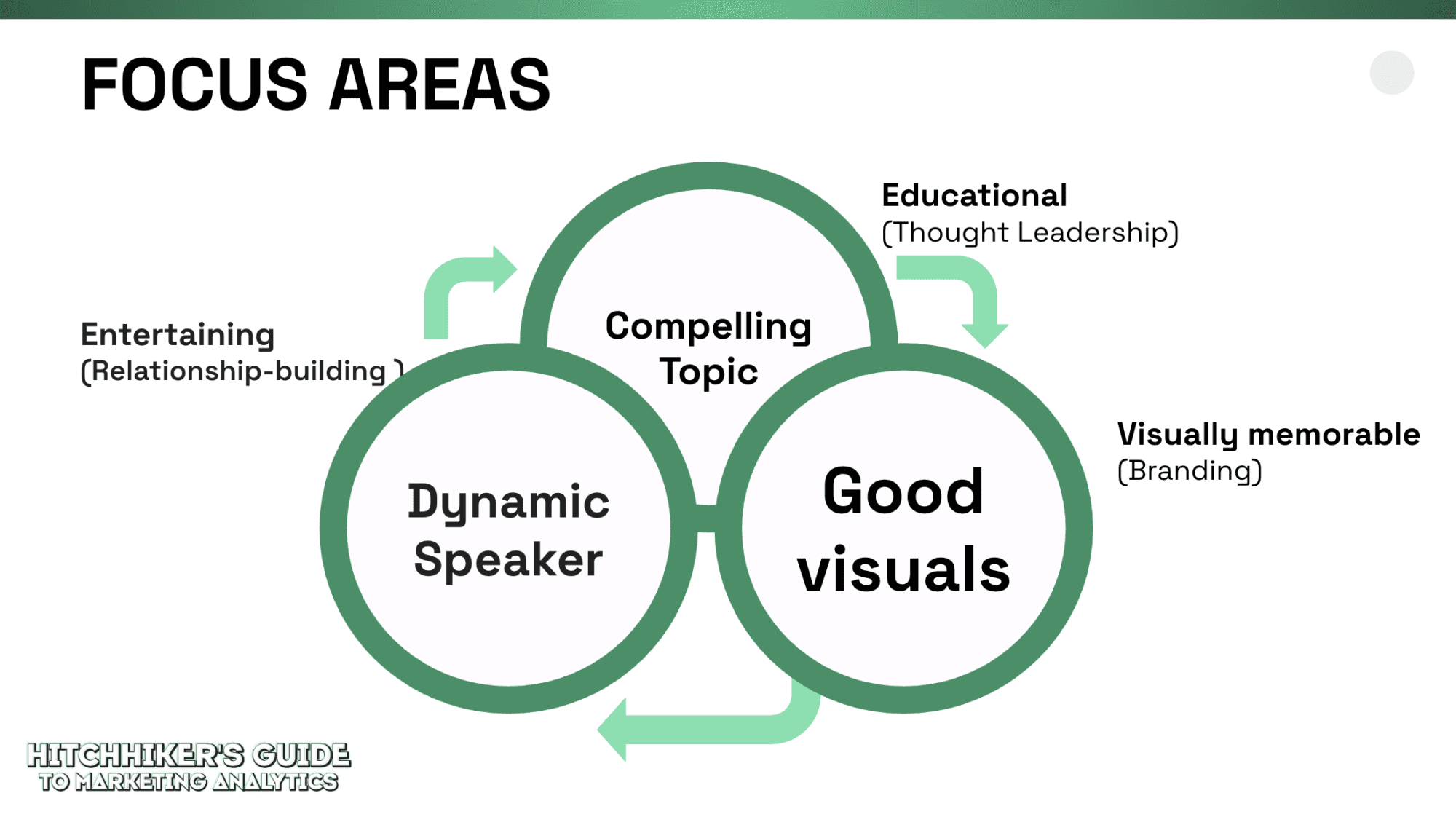
Early in the program’s design, Nadia Davis, VP of Marketing at CaliberMind, articulated a simple but demanding standard for what qualified as a Hitchhiker’s Guide session. Each event needed to deliver on three dimensions simultaneously:
- Educational enough to earn trust
- Engaging enough to sustain attention
- Visually coherent enough to reinforce the brand.
This “magic trifecta” — compelling topics, credible speakers, and thoughtful presentation — served as a filter. If a session could not meet that bar, it did not belong in the series. This constraint intentionally limited volume, but it protected quality.
As Nadia Davis put it, the most effective gut check was straightforward: would you want to attend this yourself? If the answer was no, the audience likely felt the same.
How to apply this: Before committing to a webinar topic, pressure-test it internally with the same skepticism you would apply to your own calendar. If it doesn’t feel worth an hour of your time, it’s unlikely to earn trust externally.
Designing a series, not a schedule
Treating webinars as a series introduced a different planning posture. Topics were selected based on narrative continuity rather than projected registration numbers. Sessions built on one another, assuming returning viewers rather than starting from first principles each time.
Speaker recruitment followed the same logic.
CaliberMind treated speaker selection as a strategic lever. The goal was not to fill slots quickly, but to curate voices with genuine credibility and a point of view that aligned with the series narrative. This often meant recruiting thought leaders who were already thinking deeply about the topic, rather than asking speakers to stretch into unfamiliar ground.
As Nadia emphasized, strong speakers reduce downstream work:
- Less content rewriting
- Fewer forced angles
- More natural delivery that audiences can feel
How to apply this: Prioritize speaker–topic fit over name recognition. Start with what you want the audience to learn, then find people who already live in that problem space. You’ll spend less time coaching and more time elevating the conversation.
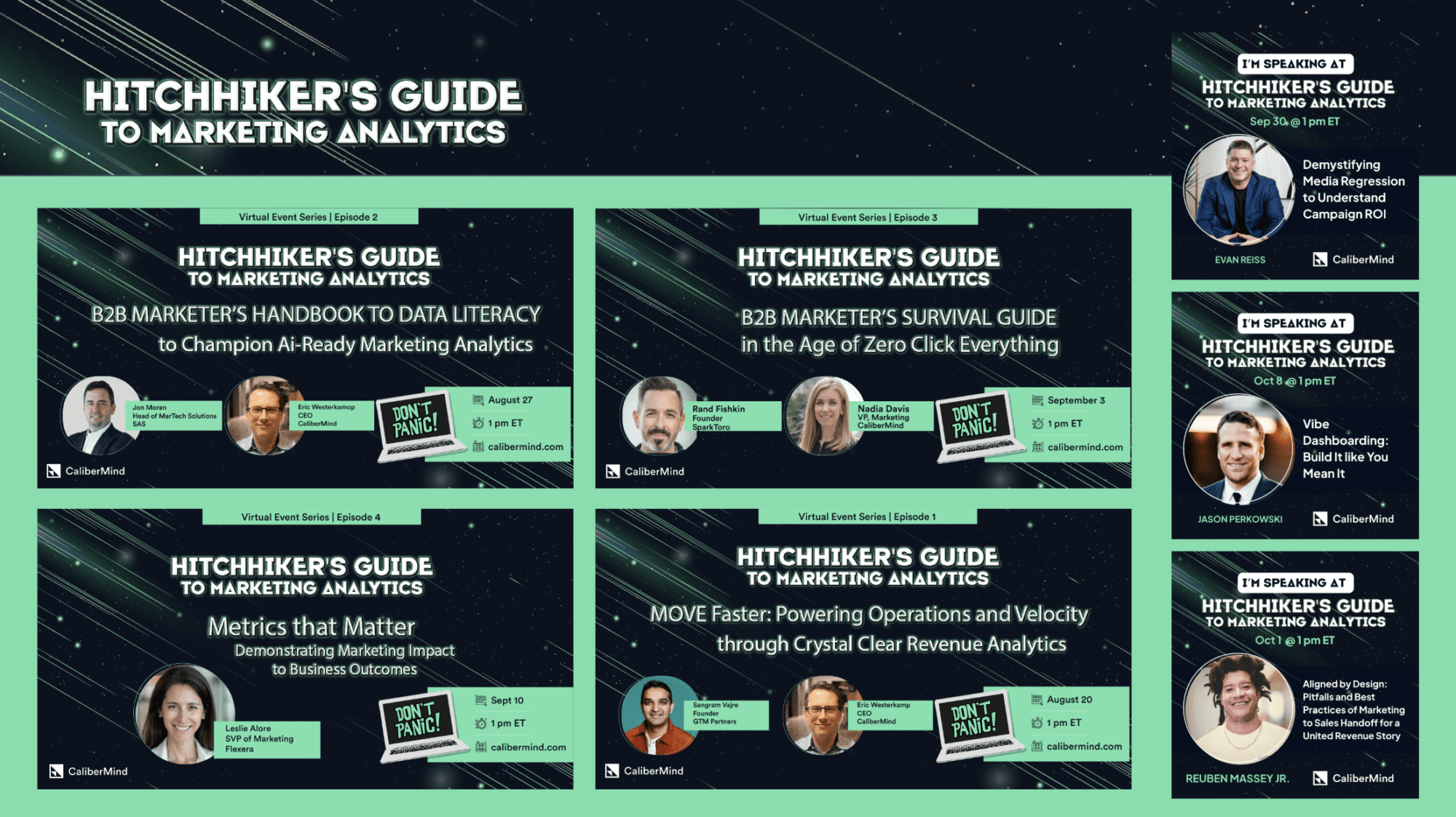
CaliberMind prioritized subject-matter experts and practitioners with distinct points of view, often aligning topics with speakers’ existing expertise rather than forcing them into pre-defined agendas. The goal was to make participation easy and worthwhile, while creating content that audiences would actively choose to spend time with.
This orientation required more forethought, but it reduced long-term friction. Over time, the series attracted more than 300 unique attendees, many of whom engaged across multiple sessions. Collectively, audiences spent 540+ hours on CaliberMind’s site, interacting with content that lived well beyond the live broadcast window.
Infrastructure that supports longevity
To support this mode of engagement, CaliberMind relied on Sequel as the underlying event infrastructure.
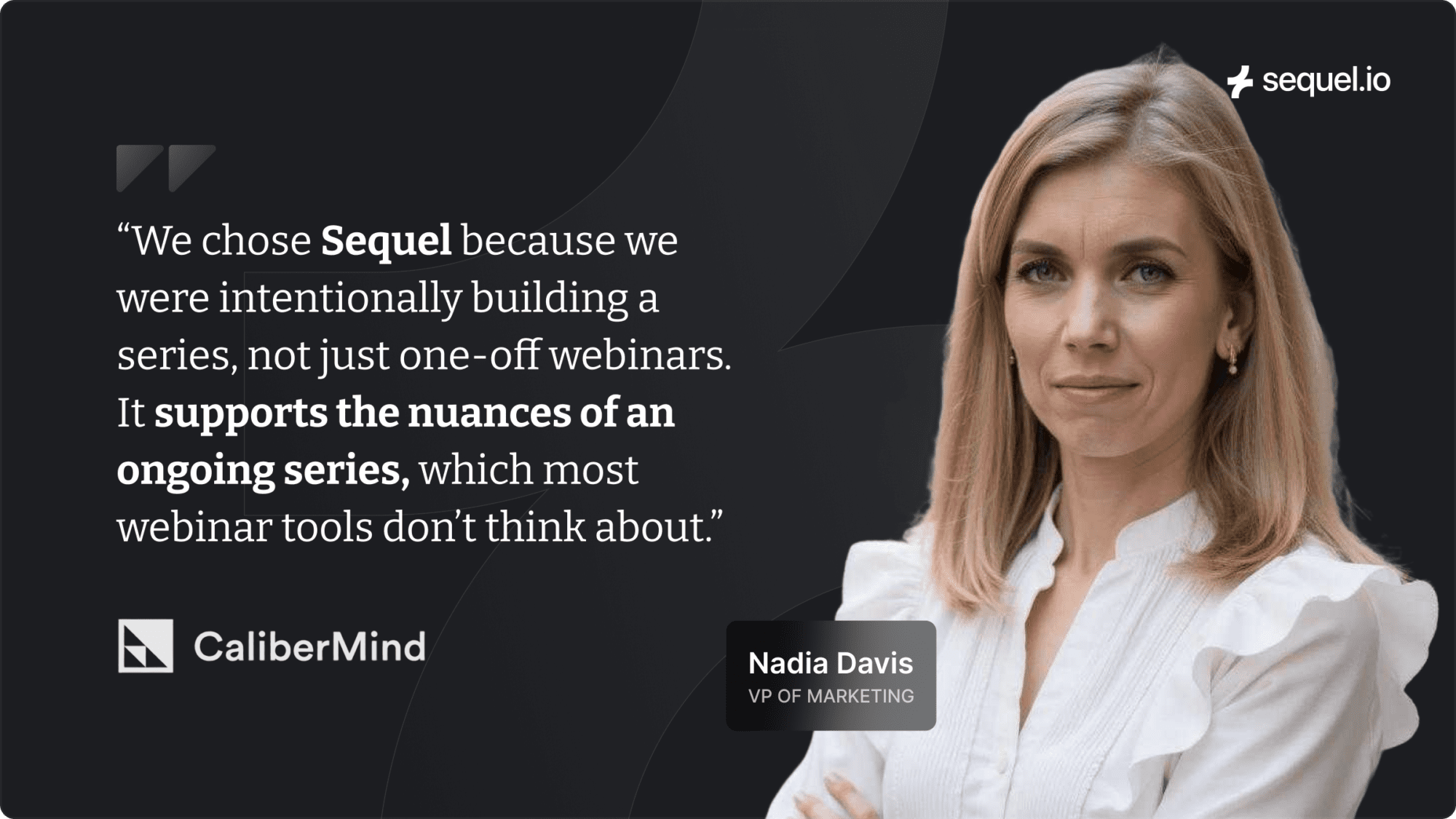
Other options were considered — traditional webinar platforms and event tools that hosted experiences off-site, like Goldcast, Livestorm, BigMarker, & ON24 — but the team ultimately chose not to use to them. Those tools would have fractured the experience, pulling audiences away from CaliberMind’s ecosystem and limiting long-term brand continuity.
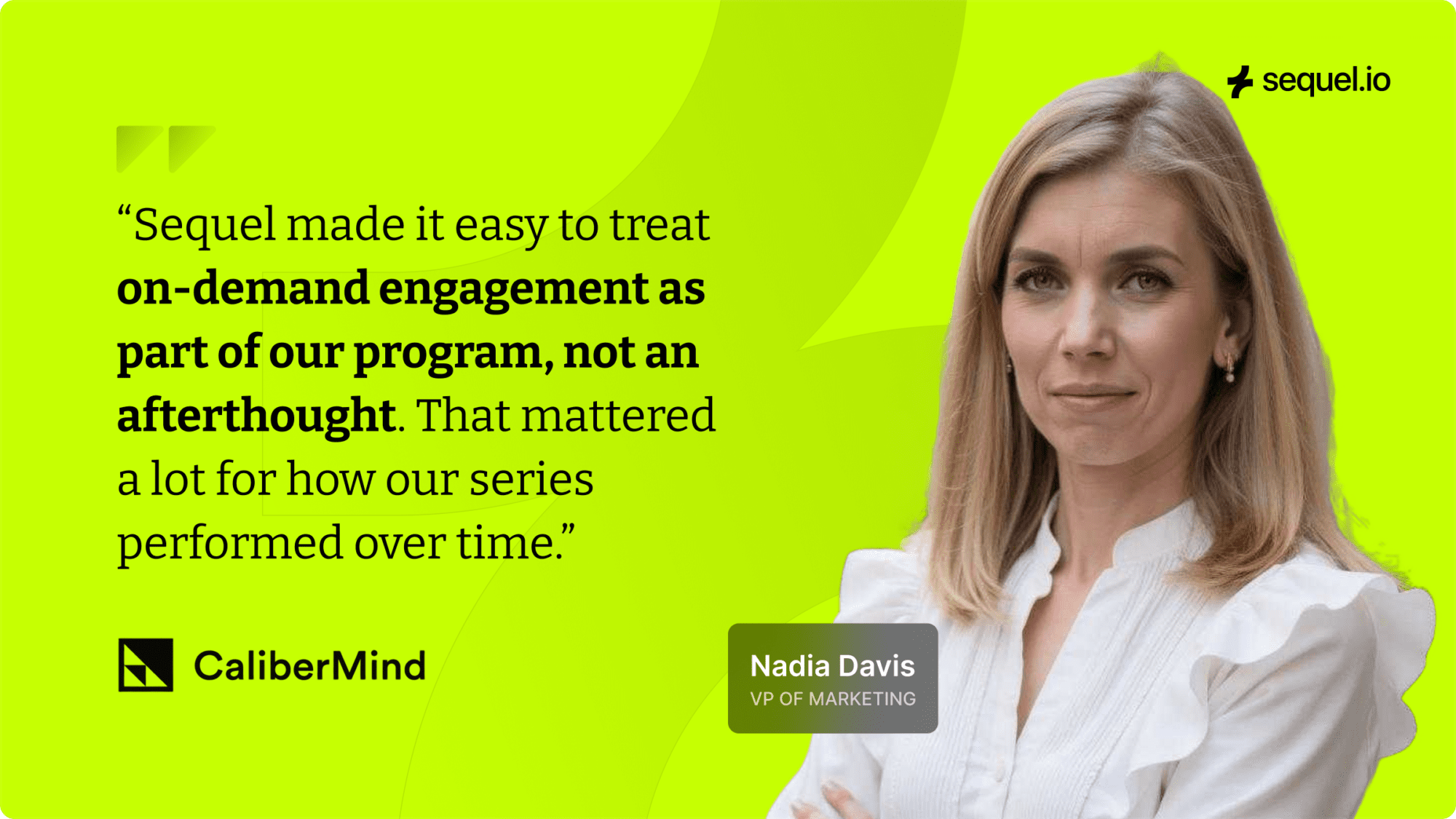
Sequel enabled the Hitchhiker’s Guide to live natively on CaliberMind’s site, preserving ownership of the experience while supporting both live and on-demand engagement within a single, coherent system.
Hosting the series directly on their site preserved brand continuity and allowed on-demand viewing to function as a core part of the experience rather than an afterthought.
By keeping the entire Hitchhiker’s Guide experience within CaliberMind’s owned environment, the team avoided the fragmentation that often comes with off-site webinar tools. Audience members didn’t feel like they were stepping into a third-party product; they stayed within a consistent brand experience across sessions.
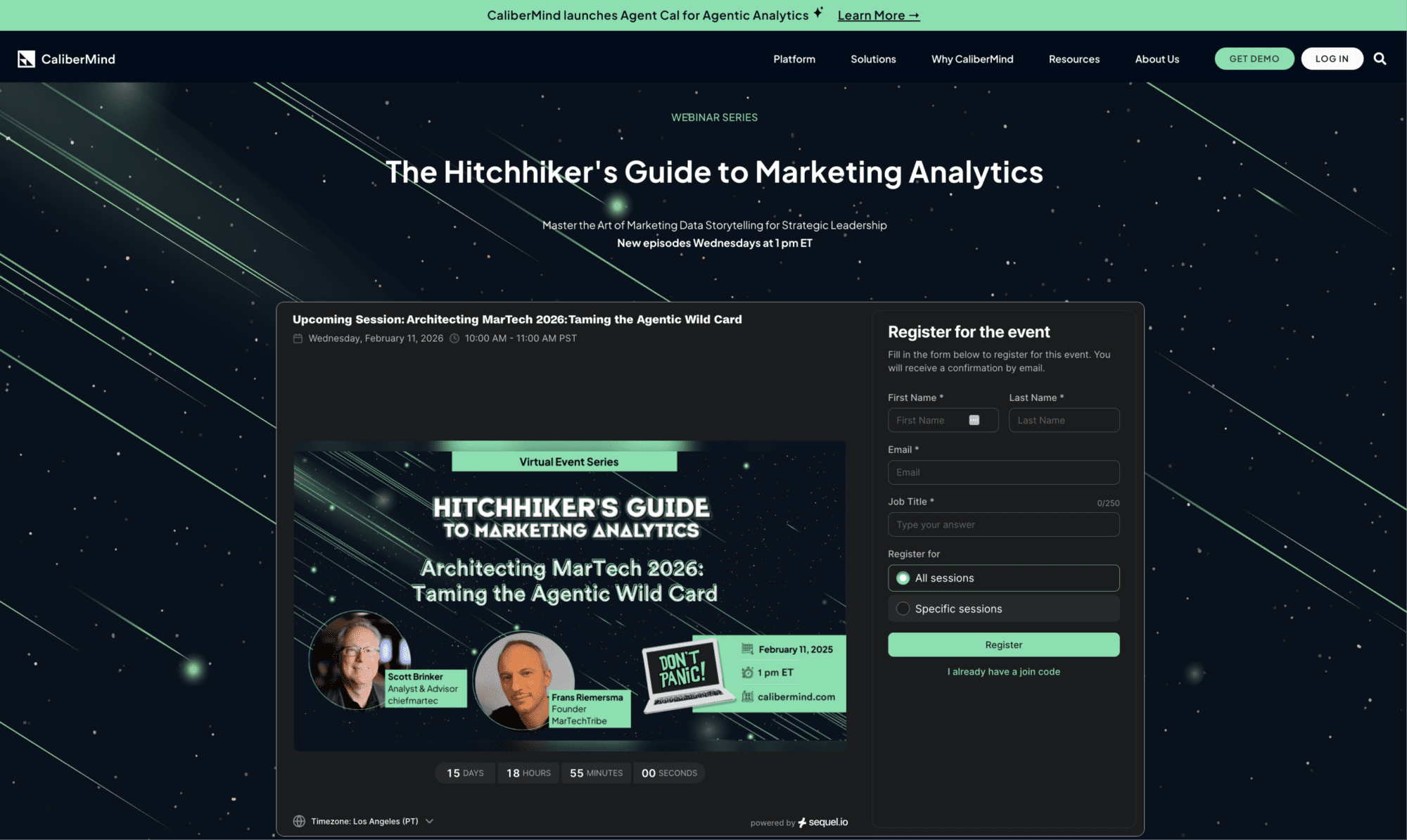
This infrastructure choice was not about features; it was about longevity. Supporting live and on-demand engagement in the same place, with clean data flowing into downstream systems, made it possible for the series to mature without accumulating operational debt.
How to apply this: If you plan to run more than a handful of events, treat infrastructure as a strategic decision. Ask whether your tooling can support continuity, brand ownership, and long-term measurement without forcing workarounds or resets.
Setting expectations internally
One of the most consequential shifts happened inside the organization.
Rather than positioning the Hitchhiker’s Guide as a simple demand-generation engine, Nadia articulated its value in terms of brand building, thought leadership, and relationship development. These goals were explicit from the outset, which helped align stakeholders and avoid misaligned expectations.
This clarity mattered because marketing does not operate under the same conditions as sales or finance. Revenue teams often work with clean, transactional data. Marketing engagement data is inherently messier, especially for programs designed to influence buying groups over time.
Instead of forcing webinar performance into short-term attribution models, they evaluated success through indicators such as:
- Sustained engagement
- Repeat attendance
- Influence on open opportunities
How to apply this: Align stakeholders early on what success looks like for a series. Document which signals matter at different stages (early awareness, mid-funnel influence, late-cycle reinforcement) so webinars aren’t retroactively judged by metrics they were never designed to optimize.
Measuring webinars as part of a system
As the series matured, CaliberMind shifted measurement away from individual event performance and toward ecosystem-level impact.
Webinar engagement was analyzed in context: how it appeared before opportunities opened, during active sales cycles, and after deals were already in flight. On-demand participation was treated as equally important as live attendance.
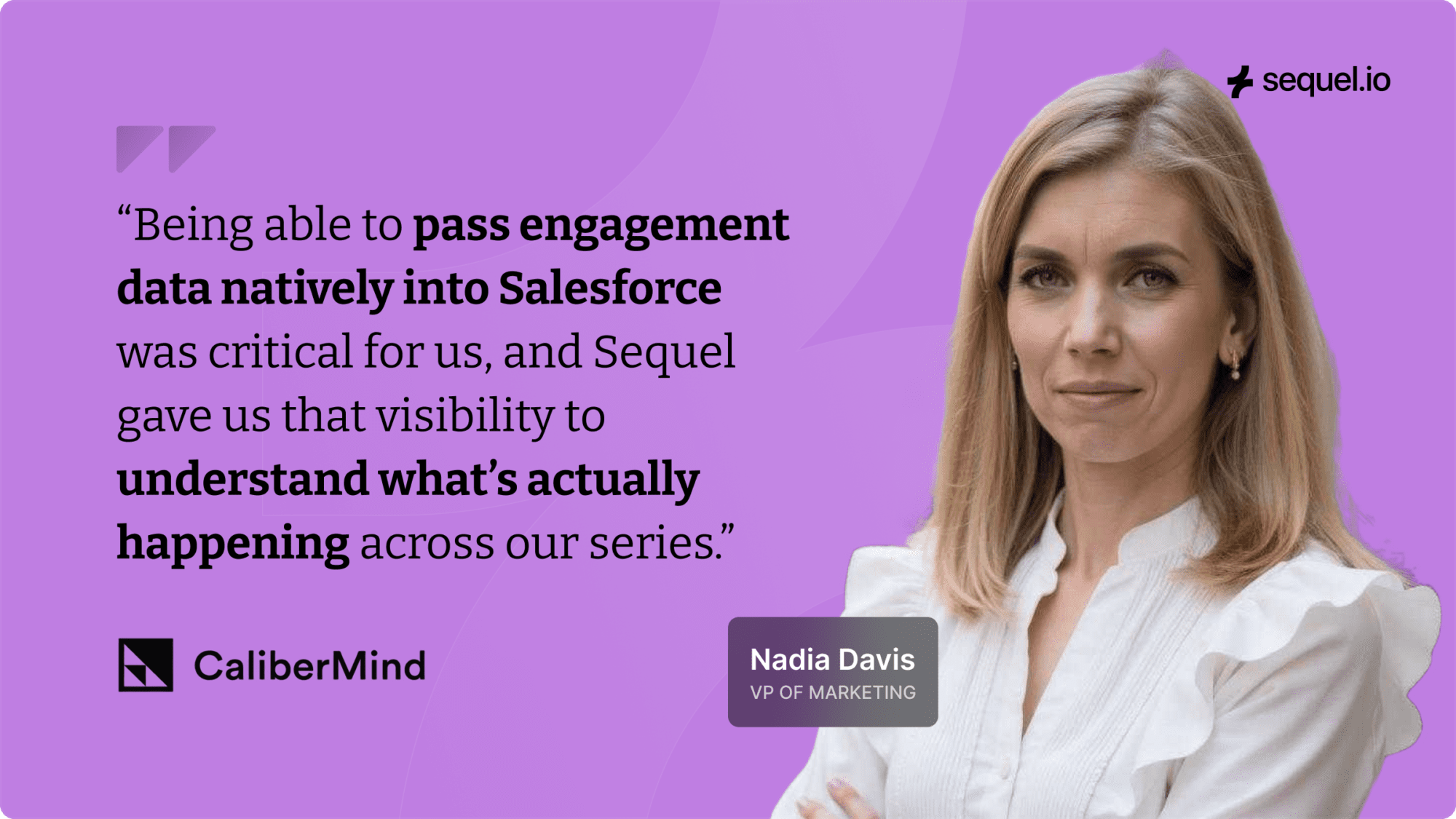
Sequel’s native integrations into CRM and marketing systems made this possible.
Rather than treating webinar engagement as a standalone data point, CaliberMind could see it alongside other marketing touches and sales activity. This made it easier to understand when webinars mattered most in the journey, not just if they occurred.
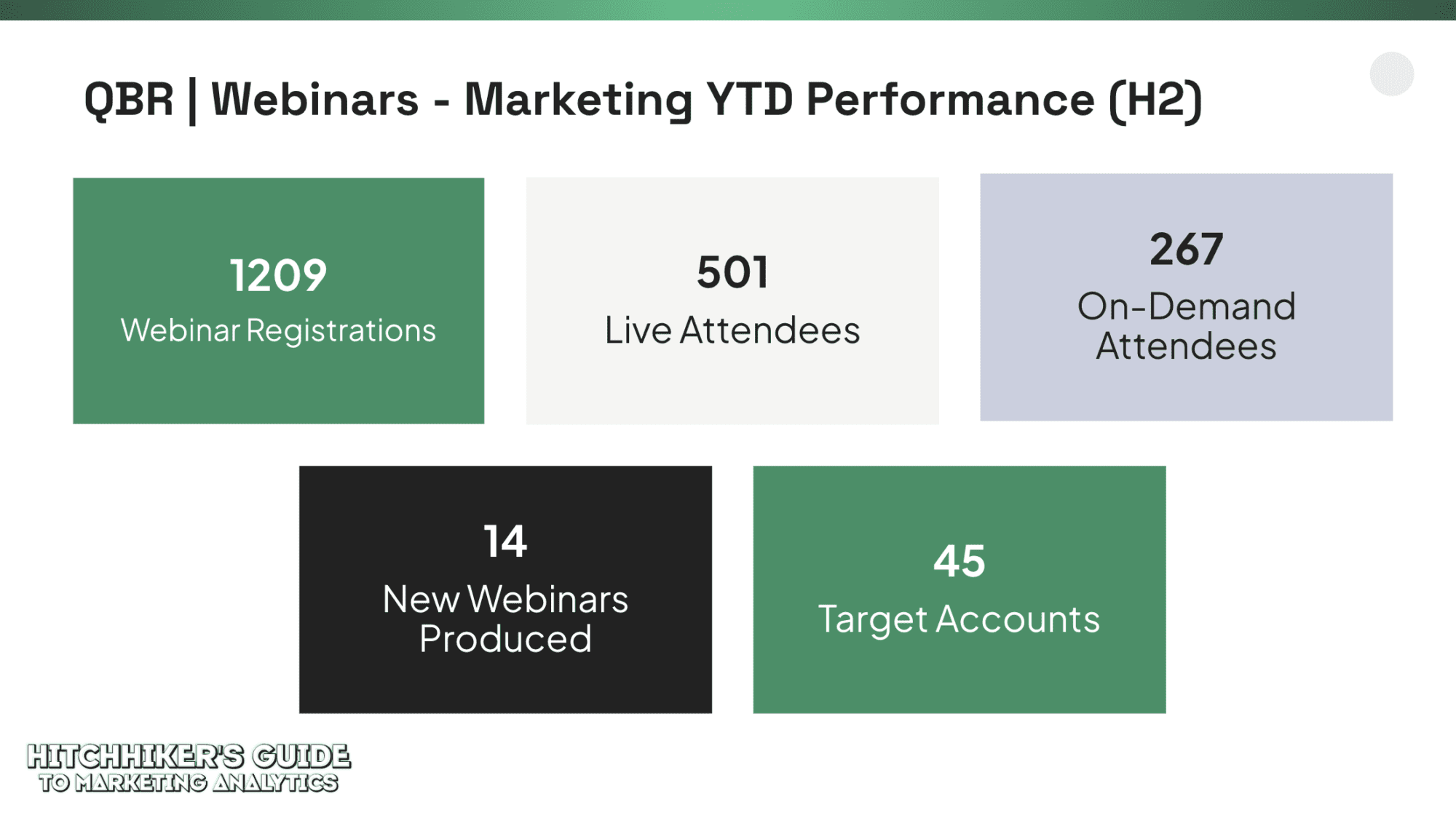
Engagement data flowed directly into CaliberMind’s CRM environment, allowing the team to see webinar touches alongside other marketing interactions and sales activity.
Viewed through this broader lens, the Hitchhiker’s Guide overlapped with more than $4M in influenced pipeline. This was not interpreted as direct causation, but as evidence that sustained, relevant engagement alters buyer behavior over time.
How to apply this: Ensure your webinar data flows into the same systems your revenue teams rely on. Context matters more than volume, and disconnected data limits the questions you can reasonably answer.
Final thoughts: what compounds when you stop resetting
The most instructive outcome of the Hitchhiker’s Guide is not any single metric. It is what happened once CaliberMind stopped treating webinars as isolated efforts.
Over time, the series:
- Influenced $4M+ in pipeline
- Engaged 300+ unique attendees
- Generated 540+ hours of meaningful interaction on CaliberMind’s site
These outcomes were not engineered through optimization tricks or aggressive promotion. They emerged because the team committed to continuity and allowed the system to mature.
For senior marketing leaders, this reframes what webinar ROI can look like when evaluated through a longer lens.
For practitioners, it offers a more sustainable model for planning and execution.
And for organizations willing to invest in coherence rather than constant reinvention, it demonstrates that webinars are most valuable not as moments, but as systems.
When teams stop resetting the work, the work finally begins to add up.
If you want to see how you can replicate this playbook and what it would look like to host webinars on your website, find time to talk with our team of experts here.